Duck Pond Redneckery


Looking at that wholesale solar site.

Looks like the dollar per watt ratio goes way up when the voltage goes down.

:confused-96:

12 volt panels are more expensive per watt. Significantly.

I wonder if that's because of the technology or because they simply produce more of the higher voltage models. Nobody buys a whole pallet of 12 volt panels, they buy one or two for an RV.

The higher voltage models are usually sold by the pallet for big arrays like @Blood's. They probably only sell them individually as replacements when they get damaged.


It's not a problem bringing two marine batteries though. I always do anyway because it's an eight mile river trip, and pushing a 1300 lb barge at 3 mph tops including drift, 40 amps, that's almost 3 hours. With the stereo going, I'll call it 3 x 40 amps, so 120 amp hours.

Each of my batteries are 120 amp hours. You're not supposed to discharge them below 50% state of charge. So that's why I have two.
It's easier to make an inverter that runs off of a higher input (DC) voltage. That results in lower currents in the switching trsnsistors for a given output power rating. Transistors built to handle higher currents get expensive real quick.

So, they're selling more of the high voltage arrays, meaning the manufacturer can leverage the savings he gets on higher component buys into lower final product costs.
:confused-96::confused-96::confused-96:

All true, but you're talking about stuff that's all downstream from the panels.

My guess is the 12V systems probably tend to have larger individual cells to keep the wattage up. The number of cells determines voltage, the size determines current under a given light source.
If you sell large enough quantities, the price of the product in electronics drops precipitously. The inverter is an integral part of any large solar array... hardly anyone is going to use just a straight DC output. Hence the demand for higher voltage arrays.
 
If you sell large enough quantities, the price of the product in electronics drops precipitously. The inverter is an integral part of any large solar array... hardly anyone is going to use just a straight DC output. Hence the demand for higher voltage arrays.
You're still missing the point. Unless the topic has shifted, the question was why the price of the panel goes up if the voltage goes down while wattage remains the same.

It has nothing to do with inverters.

But you could be right about the higher voltage panels being made in larger quantities, thus being cheaper.
 
Actually it does... what's the point of having a large solar array, except to provide power? And what kind of power are we looking for? Not DC 12V... you're looking to supply 115VAC, 60Hz. Thus, you're going to be supplying the DC output of a large solar array to an inverter.
 
Actually it does... what's the point of having a large solar array, except to provide power? And what kind of power are we looking for? Not DC 12V... you're looking to supply 115VAC, 60Hz. Thus, you're going to be supplying the DC output of a large solar array to an inverter.
What the hell does that have to do with why 12 volt panels are more expensive per watt?

And no, some people actually would prefer 12 volt power.
 
What the hell does that have to do with why 12 volt panels are more expensive per watt?

And no, some people actually would prefer 12 volt power.
1. Increased orders of solar cells for the higher voltage units, results in a lower per unit cost for the cells used in that product. The 28V units are cheaper to manufacture. Even if the same device is used, the lower per unit cost will only reflect in the price of the higher volume end unit when the selling price point is calculated.

2. You may prefer 12V units, but that doesn't effect the manufacturing economics. If there is a user who buys massive quantities of a different solar cell array, that will decrease the cost. It'll show up in the metrics of cost per watt.
That's exactly what I said earlier. Pay attention. ;)
 
14192726_1182572268471052_8500796788916276880_n.jpg
 
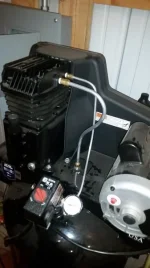
Working on the lawnmower brake, I fired up my air compressor to blow out all the grass.

Tank was empty because I drained it intending to replace the crappy POS truck style cable-pull drain valve with a real one made for trucks but never got around to it.

Anyway when the damn thing filled up & shut off, it drained itself out the unloader valve.

:mad:

Removed unloader valve & there's nothing wrong with it.

With the unloader valve held shut it was still letting air out from the pump.

20160909_192716.webp

The check valve on the top center of the tank was letting air out.

Those valves don't fail. They're too simple. It's just a spring holding a nylon seal up against the inlet hole. Incoming air overpowers the spring.

:mad:

I removed it & this was stuck in it. I don't know what it is but it's not metal. The head gaskets on the pump are rubber but this is more like brittle fiber. It was one piece but I broke it up with my fingers testing to see how strong it was.

20160909_191948.webp

Sharpie is in it for scale but here's a closeup.

20160909_191822~2.webp

I took apart the air filter and there's no material like that in it, nor was it loose where something could've been sucked in around it.

:dunno:

I used my dad's little $45 Harbor Freight pancake compressor to blow out the check valve & the steel tubing and I ran the compressor a few seconds with the pump-to-tank tube removed, then put it all back together, ran it up to 20 psi & turned it off. No leaks.

Ran it up to 150 & there's still no leaks, except for that stupid drain valve I still need to replace. (might just put the original wingnut drain valve on it temporarily).


Any ideas what that debris is?

Like I said, the head gaskets (yes there are two) are rubber and I've had these pumps apart before & the reed valves are steel.

I don't want to pull the head off of this thing if I don't have to.

When my old oilless direct drive compressor had debris in the check valve, autopsy showed it was a piece of a reed valve that had come apart. But that's steel. This is brittle fiber type stuff like what Detroit gaskets are made of.
 
Working on the lawnmower brake, I fired up my air compressor to blow out all the grass.

Tank was empty because I drained it intending to replace the crappy POS truck style cable-pull drain valve with a real one made for trucks but never got around to it.

Anyway when the damn thing filled up & shut off, it drained itself out the unloader valve.

:mad:

Removed unloader valve & there's nothing wrong with it.

With the unloader valve held shut it was still letting air out from the pump.

View attachment 36224

The check valve on the top center of the tank was letting air out.

Those valves don't fail. They're too simple. It's just a spring holding a nylon seal up against the inlet hole. Incoming air overpowers the spring.

:mad:

I removed it & this was stuck in it. I don't know what it is but it's not metal. The head gaskets on the pump are rubber but this is more like brittle fiber. It was one piece but I broke it up with my fingers testing to see how strong it was.

View attachment 36225

Sharpie is in it for scale but here's a closeup.

View attachment 36226

I took apart the air filter and there's no material like that in it, nor was it loose where something could've been sucked in around it.

:dunno:

I used my dad's little $45 Harbor Freight pancake compressor to blow out the check valve & the steel tubing and I ran the compressor a few seconds with the pump-to-tank tube removed, then put it all back together, ran it up to 20 psi & turned it off. No leaks.

Ran it up to 150 & there's still no leaks, except for that stupid drain valve I still need to replace. (might just put the original wingnut drain valve on it temporarily).


Any ideas what that debris is?

Like I said, the head gaskets (yes there are two) are rubber and I've had these pumps apart before & the reed valves are steel.

I don't want to pull the head off of this thing if I don't have to.

When my old oilless direct drive compressor had debris in the check valve, autopsy showed it was a piece of a reed valve that had come apart. But that's steel. This is brittle fiber type stuff like what Detroit gaskets are made of.
Mechanic man says it sounds like something got sucked into it somehow.

Might be something that was in the tank from the manufacturer.

That's all I got.
 

Back
Top