Duck Pond Redneckery


...and double check everything. Grabbing onto something non-electrical and getting zapped is seriously stupid, so with stupid **** going on you need to check all the basic stuff - including stuff done by an "electrician."

Something like a floating ground at the barn, and having hot connected somewhere as "ground" could do that. There's not a return path, so you don't pop breakers, but you've got things that you would not consider hot actually at a high enough potential that you get zapped.

Stupid ****, ya know?
Yeah, I'm thinking remote panels are supposed to be 4-wire connections: 2 hots, neutral and ground, and that remote box should be grounded to earth as well.
 
Selfie time.
tumblr_o3oiq0kIUB1s4k1aro1_500.jpg

Yeah that's right, I'm BATDUCK.

Fixed..
 
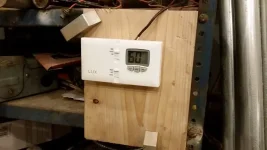
I went ahead and hooked up the thermostat last night because it got up to 76° in there yesterday before dark.

20161222_215750.webp

That's obviously temporary until I get that part of the wall done.


That thermostat is kind of cool. You can program the swing.

The swing is how many degrees below the setpoint it will let it go before it turns on the heater. With a larger swing, it results in fewer, but longer cycles. Not so good for comfort while I'm in there but good for idling the heat at 50° at night once I get done with the walls and insulation and it actually becomes practical to do so.

Default is "#4". The manual doesn't say 4 degrees, it says "#4". I don't know if that is 4 degrees and if so, why they typed it that way. :dunno:

But it can be set from #2 to #9.
 
Yeah, I'm thinking remote panels are supposed to be 4-wire connections: 2 hots, neutral and ground, and that remote box should be grounded to earth as well.
Yep, basic 115/208 VAC service. If its coming straight off the power pole, its two hots and neutral in, safety ground bonded to neutral at the power entry point.
 
What blows my mind is how a 16 gauge solid steel wire with a copper coating can carry enough power to run a whole town 30 miles away from the nearest power plant.

Yeah I know it's ten thousand volts but still,..
 
What blows my mind is how a 16 gauge solid steel wire with a copper coating can carry enough power to run a whole town 30 miles away from the nearest power plant.

Yeah I know it's ten thousand volts but still,..

The high transmission voltages mean there's no need for high currents - the current is what causes heating and transmission losses.

P = V x I

30 kW (3-phase) can be sent across 3 cheap lines at 10 kV and 1 Amp per phase. Hook it to a step down transformer 208/115 VAC, 3-phase, and you get around 90 amps per phase.

That's why there's a safety ground at local service. You don't want to complete the circuit in a bolted single-phase fault... hot to ground with a broken neutral. The safety ground provides an alternate path back to the breaker - that's supposed to open. In theory.
 
Last edited:
The high transmission voltages mean there's no need for high currents - the current is what causes heating and transmission losses.

P = V x I

30 kW (3-phase) can be sent across 3 cheap lines at 10 kV and 1 Amp per phase. Hook it to a step down transformer 208/115 VAC, 3-phase, and you get around 90 amps per phase.
Get this... There's ONE skinny little wire on the pole feeding this place. One wire plus the lightning diverter at the top but it bypasses this pole.

And I've got 200 amp service here.

The line coming down this road has three wires (plus lightning diverter) but two of them end at the sod farm next door. No idea what kind of service they have but there are 4 big aerial cables coming off their transformer. I've got two insulated cables plus the bare galvanized steel carrier wire.

You've got 208VAC 2-phase, delta-connected at the power pole. Each phase connected across a local ground at the house (Y-connected) gives you 208VAC appliance service (hot to hot,) and 115VAC for outlets, (hot to neutral.)
 
You've got 208VAC 2-phase, delta-connected at the power pole. Each phase connected across a local ground at the house (Y-connected) gives you 208 appliance service, and 115VAC for outlets.
Measuring between one hot and neutral gives me 119 volts.

Combining two hots (no neutral) doubles the voltage to 238 for appliances like my water heater, well pump, air compressor and arc welder.

Where are you getting this 208 from?


I was careful when picking my air compressor. Some of them are "dual voltage".

The dual voltage ones are simply a motor with two separate 120 volt windings. Two motors in one. You can tie them together and supply 120 volts but it'll require a 30 amp breaker and big fat wires. And it'll dim the lights when it's running.

Mine is true 240. One winding, 240 volts, only 15 amps required.


My water heater is "dual voltage" though. I made this discovery once while the power was out and I was using the generator. The microwave was the straw that broke the camel's back. It popped one of the breakers on the generator, but not the other.

Before going outside to reset it, I turned off the tandem breakers for the well pump and the water heater.

When I turned off the water heater breaker, I heard the generator change pitch as a load was removed.

If it was a single 240 volt heating element, flipping that breaker off wouldn't have made a difference as long as one of the two hots from the generator was disabled.

I wish the water heater did have a single 240 volt element instead of two 120 volt elements because it would be more efficient if it was.

It's a pretty significant increase in efficiency too, if I remember correctly from when I set out to put a 240 volt baseboard heater in my camper. (but never actually did...)
 
Actually the water heater is probably just wired incorrectly by whoever installed it.

You can probably just tie the two elements in series and feed them 240.
 
Measuring between one hot and neutral gives me 119 volts.

Combining two hots (no neutral) doubles the voltage to 238 for appliances like my water heater, well pump, air compressor and arc welder.

Where are you getting this 208 from?

Nominal @Duck. Its going to vary depending on what else is hooked up to your distribution leg. You only get on side of an interconnected triple circuit. I'll bet the sod factory doesn't load down their side very much.

I was careful when picking my air compressor. Some of them are "dual voltage".

The dual voltage ones are simply a motor with two separate 120 volt windings. Two motors in one. You can tie them together and supply 120 volts but it'll require a 30 amp breaker and big fat wires. And it'll dim the lights when it's running.

Cool! You gonna hire Eye-gore?


Mine is true 240. One winding, 240 volts, only 15 amps required.


My water heater is "dual voltage" though. I made this discovery once while the power was out and I was using the generator. The microwave was the straw that broke the camel's back. It popped one of the breakers on the generator, but not the other.

Before going outside to reset it, I turned off the tandem breakers for the well pump and the water heater.

When I turned off the water heater breaker, I heard the generator change pitch as a load was removed.

If it was a single 240 volt heating element, flipping that breaker off wouldn't have made a difference as long as one of the two hots from the generator was disabled.

I wish the water heater did have a single 240 volt element instead of two 120 volt elements because it would be more efficient if it was.

It's a pretty significant increase in efficiency too, if I remember correctly from when I set out to put a 240 volt baseboard heater in my camper. (but never actually did...)

240/120 is common too. Just depends on the power company, and how old the system is.
 
You've got 208VAC 2-phase, delta-connected at the power pole. Each phase connected across a local ground at the house (Y-connected) gives you 208VAC appliance service (hot to hot,) and 115VAC for outlets, (hot to neutral.)
Measuring between one hot and neutral gives me 119 volts.

Combining two hots (no neutral) doubles the voltage to 238 for appliances like my water heater, well pump, air compressor and arc welder.

Where are you getting this 208 from?
208V is a 4 wire commercial hookup, most residential feeds are 3 wire 120/240V.
 
...and double check everything. Grabbing onto something non-electrical and getting zapped is seriously stupid, so with stupid **** going on you need to check all the basic stuff - including stuff done by an "electrician."

Something like a floating ground at the barn, and having hot connected somewhere as "ground" could do that. There's not a return path, so you don't pop breakers, but you've got things that you would not consider hot actually at a high enough potential that you get zapped.

Stupid ****, ya know?
The short to conduit was because somehow it was leaking through that push-connect thing.

The fact there's no ground would be the electrician's fault.

He was the lowest bidder. :D

An old white haired black man my dad's friend knows. Supposedly he's retired or something but did this job cuz Ozell asked him to.

All we wanted him to do was run the feeds from the house, and make the connections in the house, at the meter, not the breaker panel, put in ONE light fixture, one outlet by the panel, and one on the rafters for the door opener. Oh and we were going to use a small 30 amp breaker panel I already had.

That was just to appease the communist building inspector whom we told this building is for storage only.

I was going to do the rest of it myself later, including the panel upgrade, (putting in the big panel for just two circuits would arouse suspicion) as needed. Meaning there would be no electric at all when I began building this workshop so I can put the outlets & lighting where I wanted instead of having to guess, then change everything later.


Well I went trucking for a week, got home and he'd wired up 8 overhead lights on two circuits, one switched only by the circuit breaker and didn't put in nearly enough outlets, but didn't allow for expansion. I am redoing damn near everything he did. :mad:

I'd have preferred there be no electric in the walls at all until I'm done with the insulation and plywood then surface mount everything. It would've been way easier and allow room for expansion without having to tear apart the walls.
 
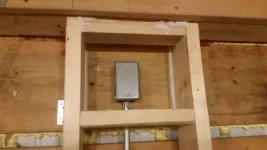
Building code says you can't permanently wall off an electrical junction box.

So I gotta make a little removable access piece here. Inside the wall behind the outdoor floodlight.

20161223_182944.webp

Just in case someone ever opens it up I should print a screaming zombie picture and tape it to cardboard and stick it in there so it's the first thing they see and it scares the shit out of them and makes them fall off the ladder. :D

Something like this:
ZombieGirl.webp
 
Never buy 2x2's, like.... ever.

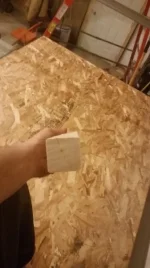
This is only a 22" piece and it's twisted almost a quarter inch.

20161223_211816.webp

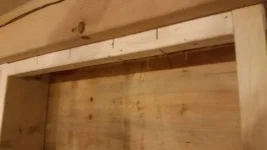
Here's what you gotta do to install them straight without breaking them. :mad:

20161223_211039.webp

In the future I'll be splitting 2x4's with the table saw.
 
You can buy 2x2's that are straight but it's going to cost you big and nobody wants to pay. The wood has to be cut at the mill then stacked with spacers (stickers) very precise and kept outside and watered with a sprinkler for a long time! Then they can be milled to the right dimension then stacked, strapped and wrapped.

Side note. Some of the most stable and expensive wood you can buy comes from a 50 year old bowling alley made of thick maple.
My local bowling alley is only 47 years old. :(
 

Back
Top