
You are using an out of date browser. It may not display this or other websites correctly.
You should upgrade or use an alternative browser.
You should upgrade or use an alternative browser.
Duck Pond Redneckery
- Thread starter Duck
- Start date


Duck
Sarcastic remark goes here
That's what happens when you barely have enough heat to compensate for what's lost through the uninsulated walls.My mechanics shop is nice and warm. He has one of those used oil burners but the temp is kept at 75 all the time 24/7. The garage is not insulated. There was a power outage once and it took forever for everything to heat back up in there. Everything got cold and kept it.
It's like this .... heat is energy, and so is motion.
How much power does it take to maintain 65mph vs how much power does it take to accelerate it to that speed?
That's why I'll probably still use the torpedo heater for "acceleration" even after its all insulated.
Hold about 80 degrees in there for half an hour and turn it off.
Combined, I've got 205,000 BTU of heating in there now.
Duck
Sarcastic remark goes here
Selfie time.
We need more pics of something, anything!


Yeah that's right, I'm BATMAN.
I think I sort of said it before but you should have built a small room in the corner like 20'x20' and insulated and a normal ceiling height like 8' and a nice sturdy work bench. That's what I had for many years and it was perfect. If you want to do anything large like working on the tractor you turn on that torpedo thingie.
Duck
Sarcastic remark goes here
No, you didn't "sort of" say it. You DID say it.I think I sort of said it before but you should have built a small room in the corner like 20'x20' and insulated and a normal ceiling height like 8' and a nice sturdy work bench. That's what I had for many years and it was perfect. If you want to do anything large like working on the tractor you turn on that torpedo thingie.
And I rejected your dumb idea.

I need a place to play with RC helicopters.
And my dad wants to build a wind tunnel for testing his kites.

Duck
Sarcastic remark goes here
Your both mental


ironpony
Professional Pot-Stirrer
Pretty obvious, huh?Your both mental
Duck
Sarcastic remark goes here
*obliviousPretty obvious, huh?
Duck
Sarcastic remark goes here
Well here's a mystery...

That outlet was working fine. I was even running the drill press off the outlet I put up high for the work light that'll eventually be over that workbench.
Rather than finishing framing out that part of the wall for plywood I decided to do the wall over the roll-up door so I can reattach the supports for the door track and be able to open it and park the tractor inside in advance of any future snow in the forecast.
Anyway I was taking measurements for the convoluted crap I have to build to wall up around the torsion spring thing and I got zapped.

I thought it was static electricity so I grabbed the torsion spring bar again and got zapped again.
I was leaning on an electrical conduit at the time.
Hopped down off the scaffold and grabbed my voltmeter and I was getting 85 volts between the conduit and the spring bar.
The conduit is grounded, and the garage door hardware is not electrically connected to anything.
So I probed an outlet by the breaker panel and I was getting 119 volts between the COMMON and the ground.
The common bus in the breaker panel is grounded, rendering all of the ground wires in the barn just a useless redundancy to appease building inspectors.
I was getting the same 119 volts from hot to common like normal too.
So a hot was shorted to the ground somehow but didn't pop any breakers.
I turned off the breaker for that west outlet and was no longer getting any voltage between the common & ground anywhere in the barn including other circuits.
I pulled the outlets back out of that box by the workbench, turned it's breaker back on, and probed around and everything was correct.
No chafed wires, no copper exposed below the push-connect wire nuts, nothing like that.
So I stuffed them back in the outlet box and again was getting 119 volts on the conduit.

I pulled it back out and simply taped up the push-connect wire nut thing on the hots.
These things:
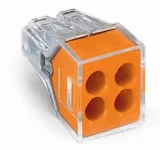
The damn thing is plastic with no bare copper exposed anywhere. But I taped it up anyway.
Shoved the outlets back in & no short to ground any more.
OK so that thing must've been bleeding power to the back of the outlet box.
OK so far that's just basic troubleshooting...
Here's the real mystery.
Power was going from the hot straight to ground, and therefore the common.
Why didn't it pop the circuit breaker, and why did both the LED light and my drill press work just fine while it was shorted?

I tested the circuit breaker by simply taking a screwdriver and jamming it between the inside of the outlet box and the terminal screw on the hot side of the outlet.
It made an arc, audible pop, and the LED light went out - circuit breaker popped.
I don't get it...
Whatever though, wrapping up that push-connect thing seems to have fixed it.
I've never used those things before but they were already in that box. The electrician who originally put power in there used them in just that one outlet box... so far. There are two more of those outlets I haven't opened yet.
Maybe I fucked them up when I yanked the old wires out with pliers.
Other mystery is even with hot shorted to the ground, how in the hell was I getting 119 volts between ground and common when the two are tied together in the panel?
That short should've gone straight to earth ground via the common wire in from the house.
I'm going to put a 6 foot copper ground rod on my Menard's list and ground the panel.
That outlet was working fine. I was even running the drill press off the outlet I put up high for the work light that'll eventually be over that workbench.
Rather than finishing framing out that part of the wall for plywood I decided to do the wall over the roll-up door so I can reattach the supports for the door track and be able to open it and park the tractor inside in advance of any future snow in the forecast.
Anyway I was taking measurements for the convoluted crap I have to build to wall up around the torsion spring thing and I got zapped.
I thought it was static electricity so I grabbed the torsion spring bar again and got zapped again.
I was leaning on an electrical conduit at the time.
Hopped down off the scaffold and grabbed my voltmeter and I was getting 85 volts between the conduit and the spring bar.
The conduit is grounded, and the garage door hardware is not electrically connected to anything.
So I probed an outlet by the breaker panel and I was getting 119 volts between the COMMON and the ground.
The common bus in the breaker panel is grounded, rendering all of the ground wires in the barn just a useless redundancy to appease building inspectors.
I was getting the same 119 volts from hot to common like normal too.
So a hot was shorted to the ground somehow but didn't pop any breakers.
I turned off the breaker for that west outlet and was no longer getting any voltage between the common & ground anywhere in the barn including other circuits.
I pulled the outlets back out of that box by the workbench, turned it's breaker back on, and probed around and everything was correct.
No chafed wires, no copper exposed below the push-connect wire nuts, nothing like that.
So I stuffed them back in the outlet box and again was getting 119 volts on the conduit.
I pulled it back out and simply taped up the push-connect wire nut thing on the hots.
These things:
The damn thing is plastic with no bare copper exposed anywhere. But I taped it up anyway.
Shoved the outlets back in & no short to ground any more.
OK so that thing must've been bleeding power to the back of the outlet box.
OK so far that's just basic troubleshooting...
Here's the real mystery.
Power was going from the hot straight to ground, and therefore the common.
Why didn't it pop the circuit breaker, and why did both the LED light and my drill press work just fine while it was shorted?
I tested the circuit breaker by simply taking a screwdriver and jamming it between the inside of the outlet box and the terminal screw on the hot side of the outlet.
It made an arc, audible pop, and the LED light went out - circuit breaker popped.
I don't get it...
Whatever though, wrapping up that push-connect thing seems to have fixed it.
I've never used those things before but they were already in that box. The electrician who originally put power in there used them in just that one outlet box... so far. There are two more of those outlets I haven't opened yet.
Maybe I fucked them up when I yanked the old wires out with pliers.
Other mystery is even with hot shorted to the ground, how in the hell was I getting 119 volts between ground and common when the two are tied together in the panel?
That short should've gone straight to earth ground via the common wire in from the house.
I'm going to put a 6 foot copper ground rod on my Menard's list and ground the panel.
Last edited by a moderator:
I need a place to play with RC helicopters.
I would fly my little helicopter in the house. I have forced hot air. The heat would come on and blow it into the wall.
ironpony
Professional Pot-Stirrer
Depends... if he has a separate line feeding the man cave, it should be bonded there too.IIRC from when I moved the house, if the neutral and ground are bonded at the initial service panel, any panels downstream from there should not be bonded. Too tired to remember why...
One bond point prevents setting up ground loops.

Ground the barn, and the barn panel should not be bonded.200 amp panel in the basement added by previous owner.
Electrician put a 100 amp breaker in that panel and ran heavy stuff underground to the barn. Two hots and a neutral. No ground.
ironpony
Professional Pot-Stirrer
...and double check everything. Grabbing onto something non-electrical and getting zapped is seriously stupid, so with stupid shit going on you need to check all the basic stuff - including stuff done by an "electrician."
Something like a floating ground at the barn, and having hot connected somewhere as "ground" could do that. There's not a return path, so you don't pop breakers, but you've got things that you would not consider hot actually at a high enough potential that you get zapped.
Stupid shit, ya know?
Something like a floating ground at the barn, and having hot connected somewhere as "ground" could do that. There's not a return path, so you don't pop breakers, but you've got things that you would not consider hot actually at a high enough potential that you get zapped.
Stupid shit, ya know?







Similar threads

- Replies
- 7
- Views
- 63

- Replies
- 12
- Views
- 48

- Replies
- 0
- Views
- 6
