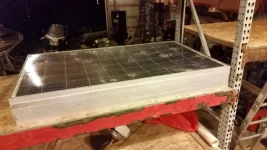
Duck Pond Redneckery


@Blood was here.

20160819_003422.webp

20160819_001508.webp

@Hammer166 check this out.

I didn't know tree hugging technology had reached this level of efficiency yet.

20160818_234940.webp

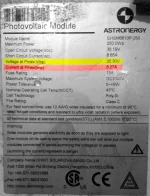
What is Pmax? Peak power I'm assuming.

Maximum power 250 Wp? What's Wp? Watt peak?

Blood said that in spite of the hail damage they still put out 28 volts or so on the meter.
 
Last edited by a moderator:
Harbor Freight has a kit. Three 15 watt panels for a 45 watt system. $200 but sometimes on sale cheaper.

At peak, 30 volts times 8 amps =240 watts.

Two of them would theoretically run my trolling motor. :)

But he brought 5. :D

1200 watts. :confused:

Have I ever mentioned that @Blood is a good guy to know? ;)

And the guy who gave Blood something like 300 of them is a REALLY good guy to know. ;)

I wonder what these things cost new. :stare1:


My mind is reeling at the moment.

I'm thinking at this point I may only need to bring one individual panel if I do this 3 day camping thing in September that Brian wants to do. Cuz shit,... The raft stereo draws 4.5 amps at full volume and we don't usually crank it that high. What else would we be using power for? Cell phone chargers? What's that, 1 amp? So 8 amps at 28 volts, that's enough to recharge the batteries from the one mile trip to our campsite (which is mostly shaded except at high noon, but the campsite gets sunlight most of the day) in an hour or so, and I'm not concerned about the draw from the stereo and phone chargers. I could just top it off the morning when we leave, or use it to cut the draw of the trolling motor in half on the 7 mile trip from the campsite to Momence.


OK now I've got nerd questions...

OK a deep cycle battery is 12.8 volts fully charged. So two wired in series, or daisy chained as Blood calls it, would be 25.6 volts. But it's safe to run a battery at 13.6 or more volts in a vehicle system while it's running. So 27.2 volts.

If I wire these things parallel to maintain 28 volts, feeding my deep cycle batteries wired in series, it'll cook them even with the trolling motor on. So I'll have to bring a voltmeter & stay on top of that stuff.

But here's the question...

Can I hook the two batteries in series to accept the 28 volts from the solar panels but hook my 12 volt trolling motor to just one of those two batteries?

When the trolling motor draws 480 watts, from one battery, will it draw power (watts) equally from both batteries?

This is actually a question for the guy who gave my dad that boat. He's an elevator mechanic & you pretty much have to be an electrical engineer to do that.

But I can't text him at this hour because he's one of those weird "day" people who go to sleep at night and are awake in the daytime. :coocoo:


Last edited: why does it matter?​
 
Last edited by a moderator:
OK now I've got nerd questions...

OK a deep cycle battery is 12.8 volts fully charged. So two wired in series, or daisy chained as Blood calls it, would be 25.6 volts. But it's safe to run a battery at 13.6 or more volts in a vehicle system while it's running. So 27.2 volts.

If I wire these things parallel to maintain 28 volts, feeding my deep cycle batteries wired in series, it'll cook them even with the trolling motor on. So I'll have to bring a voltmeter & stay on top of that stuff.

This may not be as big a problem as you think, that 28 volts is the open circuit voltage, the voltage will fall off some depending on the load.

But here's the question...

Can I hook the two batteries in series to accept the 28 volts from the solar panels but hook my 12 volt trolling motor to just one of those two batteries?

No problem there, you're only seeing the voltage of one battery.

When the trolling motor draws 480 watts, from one battery, will it draw power (watts) equally from both batteries?

Yes and no. When the solar cells are working, they are providing the current, so it's not drawing from the battery itself, but rather straight from the cells. So it's not drawing from either battery. With no input voltage, the battery you're hooked to will be the one drawn down.

This is actually a question for the guy who gave my dad that boat. He's an elevator mechanic & you pretty much have to be an electrical engineer to do that.

But I can't text him at this hour because he's one of those weird "day" people who go to sleep at night and are awake in the daytime. :coocoo:

Last edited: why does it matter?​

Sleep? What is this thing?
 
Hammer's right. A solar cell is a current source, not a voltage source device. Depending on the light flux hitting the cell, it will generate a current proportional to the flux density, but the output voltage will depend on the attached load. The 28V figure is the nominal open circuit voltage.

I'd set aside the beer for an afternoon and play with the things before ya get dependant on them out in the boonies.

:D
 
Yes and no. When the solar cells are working, they are providing the current, so it's not drawing from the battery itself, but rather straight from the cells. So it's not drawing from either battery. With no input voltage, the battery you're hooked to will be the one drawn down.
Tempted to get a 24 volt trolling motor. :rolleyes:

So, let's say I've got the batteries wired in series for 24 volts, the solar panels wired parallel to each other for 28 volts, and connected to the batteries to charge them with 28 volts.

Trolling motor is drawing power from only one battery, and I go into a shaded bend in the river & the solar panels quit working..


When I get back out into the bright and sunny, or arrive at the campsite & turn off the trolling motor, the solar panels will dump more power into the battery that's been discharged by the motor?

Or will it be simultaneously overcharging the unused battery while charging the drained battery?


I just don't want to buy a charge controller. Probably big bucks. All a charge controller does is automate what I can do myself with a voltmeter & remembering to check them periodically & disconnect the panels when the batteries are fully charged or in the evening when the solar volts drop below the battery volts, whichever comes first.

The math works out to one panel's peak output being roughly half the draw of the trolling motor, in watts.

I think for a camping trip that's all I'd need.

I could just leave the single panel disconnected for the one mile trip from the state line to the campsite & run the trolling motor with the batteries hooked up parallel so it draws equally from both. Then when I get to the campsite I switch the cables around and so they're in series and let Helios charge them back up.

Once fully charged, I disconnect the solar panel and switch the cables back to parallel & use the batteries for the stereo & phone chargers for the duration of the camping,... Probably 20 amp hours per day, I think those batteries are 100 Ah each.. then the morning of departure I'll hook them back up in series so the solar panel can charge them back up before leaving on the 7 mile trip to Momence. Or since they'd be fully charged I could just run it balls to the wall and go upstream one mile back to the state line.

The raft will go upstream, just not very fast. Probably 1 mph groundspeed. Unless the river is at flood stage, in which case we wouldn't be camping anyway.


What would happen if I put a low draw 12 volt device like an LED tail light in series with a higher draw 12 volt device like a stereo & feed it 24 volts? :headscratch2:
 
Tempted to get a 24 volt trolling motor. :rolleyes:

So, let's say I've got the batteries wired in series for 24 volts, the solar panels wired parallel to each other for 28 volts, and connected to the batteries to charge them with 28 volts.

Trolling motor is drawing power from only one battery, and I go into a shaded bend in the river & the solar panels quit working..


When I get back out into the bright and sunny, or arrive at the campsite & turn off the trolling motor, the solar panels will dump more power into the battery that's been discharged by the motor?

Or will it be simultaneously overcharging the unused battery while charging the drained battery?

Because they're all in series, all the cells will get the same charge current, overcharging the one, and undercharging the other.


I just don't want to buy a charge controller. Probably big bucks. All a charge controller does is automate what I can do myself with a voltmeter & remembering to check them periodically & disconnect the panels when the batteries are fully charged or in the evening when the solar volts drop below the battery volts, whichever comes first.

The math works out to one panel's peak output being roughly half the draw of the trolling motor, in watts.

I think for a camping trip that's all I'd need.

I could just leave the single panel disconnected for the one mile trip from the state line to the campsite & run the trolling motor with the batteries hooked up parallel so it draws equally from both. Then when I get to the campsite I switch the cables around and so they're in series and let Helios charge them back up.

Once fully charged, I disconnect the solar panel and switch the cables back to parallel & use the batteries for the stereo & phone chargers for the duration of the camping,... Probably 20 amp hours per day, I think those batteries are 100 Ah each.. then the morning of departure I'll hook them back up in series so the solar panel can charge them back up before leaving on the 7 mile trip to Momence. Or since they'd be fully charged I could just run it balls to the wall and go upstream one mile back to the state line.

The raft will go upstream, just not very fast. Probably 1 mph groundspeed. Unless the river is at flood stage, in which case we wouldn't be camping anyway.

Just make sure you charge each battery separately when you get home to make sure they're both fully charged. I see a of simplifying your idea, that would be a three way switch (which I'm sure would likely jumper cable clamp:toothpick:) and switch back and forth between the batteries to keep their charge level roughly equal. Depending on the motor and control circuits, you might actually be able to run the motor off 24V if you don't run it wide open.


What would happen if I put a low draw 12 volt device like an LED tail light in series with a higher draw 12 volt device like a stereo & feed it 24 volts? :headscratch2:
POOF!!!!
 
Because they're all in series, all the cells will get the same charge current, overcharging the one, and undercharging the other.
Hooking the trolling motor across just one of the cells will put the impedance of the motor in parallel with the internal cell impedance of the battery the motor is hooked around. Now the battery will control the node voltage, but the other battery may see some heating because of increased current.
 
Hooking the trolling motor across just one of the cells will put the impedance of the motor in parallel with the internal cell impedance of the battery the motor is hooked around. Now the battery will control the node voltage, but the other battery may see some heating because of increased current.
The sum of the square roots of any two sides of an isosceles triangle is equal to the square root of the remaining side.

wizard_cover.webp
 
Last edited:
You know @Duck , the more I think about what you're trying to accomplish, I think you should consider opening up one of the panels, and seeing how hard it would be to electrically split it into 2 19V 125Wp panels. All you'd need then is a blade switch to disconnect the power and you'd be good to go, no need to babysit, just turn it on and go.

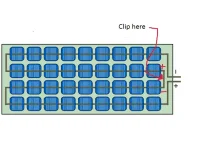
Inside the panel, you should have 60 individual cells (+/- .6V each). You should be able to take the back off, and just clip the bus wires like in this example:

upload_2016-8-20_10-12-11.webp

You'd have to run outputs from each end of the clipped wire, but that's easy. At that point, I'd hook one up to a somewhat discharged battery (~ 12V,) to see what the output voltage looks like, but it should be right around the 15V mark. 36 cells is the typical size of a panel to charge a 12V battery, so it may work. If you think voltage is still too high, you could always clip a few cells off the end of the loop to drop the voltage. (2 cells = 1V.) As long as you can access the wiring, I think this would be the best way to do want you're wanting.
 
Geezer strapped his fishing pole and a kite to his Goldwing & went to the park.

(He flies kites using a fishing pole.)
I am sorry I have fell way behind on this thread.
But flying a kite using a fishing rod is brilliant! Stronger line, Easy to reel the kite back in and it eliminates injury due to string burn, The leading cause of injury to kite flyers.:thumbsup:
 
You know @Duck , the more I think about what you're trying to accomplish, I think you should consider opening up one of the panels, and seeing how hard it would be to electrically split it into 2 19V 125Wp panels. All you'd need then is a blade switch to disconnect the power and you'd be good to go, no need to babysit, just turn it on and go.

Inside the panel, you should have 60 individual cells (+/- .6V each). You should be able to take the back off, and just clip the bus wires like in this example:

View attachment 36076

You'd have to run outputs from each end of the clipped wire, but that's easy. At that point, I'd hook one up to a somewhat discharged battery (~ 12V,) to see what the output voltage looks like, but it should be right around the 15V mark. 36 cells is the typical size of a panel to charge a 12V battery, so it may work. If you think voltage is still too high, you could always clip a few cells off the end of the loop to drop the voltage. (2 cells = 1V.) As long as you can access the wiring, I think this would be the best way to do want you're wanting.
There's a black plastic box on the back side of each panel at one end that I didn't think was relevant enough to get a picture of before I stacked them on a shelf.

So maybe. :dunno:

The cells, white plastic backing & the glass surface are all pressed & glued together into one sheet though. So there can't be any surgery on them unless there's wiring inside that box I can access.
 
I am sorry I have fell way behind on this thread.
But flying a kite using a fishing rod is brilliant! Stronger line, Easy to reel the kite back in and it eliminates injury due to string burn, The leading cause of injury to kite flyers.:thumbsup:
I had a tetrahedron kite in high school, about two foot per side. That thing had some lift! Ended up using a 1/2 drill to reel it in, and we had to be careful then, or it would split the fishing line spool with all the tension. I think it was 40lb test mono, and a gust snapped that.

It was a beaut in the air, but more work than fun to fly it.

tetrahedron-kite-2.jpg
That is also brilliant @Hammer166 . I expect genius out of @Duck Dad, Because he is an intellectual. You @Hammer166 are a trucker. So, Knock it off EH? lol:biglaugh:
 

Back
Top