Duck Pond Redneckery


Getting back to the solar panels...
I put a meter on one of the worst panels.
It tested within a volt of an undamaged panel that I disconnected from my array.

If you bolted 2 or 3 panels to 4" pontoons fashioned from PVC conduit, would that hold the weight at about 40 pounds per panel?
[Conduit is UV resistant unlike regular PVC pipe.]

And, BTW...
I'm sure you've researched raft construction since you started on your first one but why wouldn't plywood secured to 4" or 6" PVC conduit pontoons allow less draft than a full sheet of polystyrene on the surface.
Seems to me that you could estimate the displacement and achieve everything from empty to maximum payload within a coupla inches of the surface.
You could even fill them with foam if you were concerned about a breach.

Why wouldn't pontoons reduce the draft and provide better locomotion, even if the polystyrene remained in place and skipped across the surface under full load?

You could even notch out a transom at the stern and use a squirrel cage fan for a paddle wheel.
:crash:


I know a coupla back ways in to the FEMA food stash but once the zombie apocalypse hits, we may need a submarine to get across the river undetected.
@Sinister will be the designated spelunker if that's alright with you.
:)
I am in no state of mind to address this right now ( https://www.truckersforum.net/forum/threads/i-think-i-just-got-struck-by-lightning.87612/) but it's simple physics regarding draft. Geometry looking at the cross section of a pontoon vs a flat plane.
 
BTW I was going to post this earlier today.

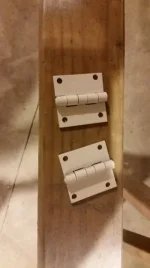
I. Made these hinges..... From scratch.

20160724_003139.webp

I started with 2-1/2" x 1/8" flat stock.

And I actually did math.

Best work I ever did I think.

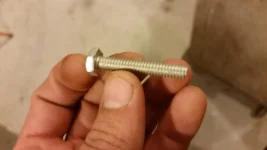
The pins are actually these metric (and therefore useless) bolts with the threads ground off with a file while they were spinning in the drill press. (I don't have a lathe).

20160724_021205.webp

The bulbous ends are weld beads ground down with the bench grinder.

I cut the edges in castleations (too drunk to spell it) with the Porta band, heated it orange with the torch while clamped in the vise, and wrapped the castleated (drunk) ends around a cheap Harbor Freight Phillips screwdriver with pliers.

I didn't have a clue in the world that it would turn out so fucking perfect. I was basically just playing with tools because Ace Hardware didn't have any cabinet hinges that would replace the ones I clumsily destroyed the other day on my big cooler.

Theyre a little sloppy & the screw holes are drilled all stupid but that's fine. Because they're f*ing homemade from f*ing scratch.

Duck style. ;)
 
Getting back to the solar panels...
I put a meter on one of the worst panels.
It tested within a volt of an undamaged panel that I disconnected from my array.
Given the fact you have so many trees on your property, were you holding the damaged panel up right beside the one on your array so they're getting the exact same sun exposure?
If you bolted 2 or 3 panels to 4" pontoons fashioned from PVC conduit, would that hold the weight at about 40 pounds per panel?
Probably. You gotta figure out the volume of the PVC tube, convert to cubic feet, multiply by 62.5 then subtract the weight of the panels and the tube itself.
One cubic foot of clear water weighs approximately 62.5 lbs. The weight of a boat or raft is calculated by the water it's displacing.
I'm sure you've researched raft construction since you started on your first one but why wouldn't plywood secured to 4" or 6" PVC conduit pontoons allow less draft than a full sheet of polystyrene on the surface.
Seems to me that you could estimate the displacement and achieve everything from empty to maximum payload within a coupla inches of the surface.
What's going to make deeper ruts in the mud? Skinny tires or big wide balloon tires?

The flat bottom raft distributes it's weight across a lot more surface area than pontoons, the same way my ATV tires distribute it's weight across larger contact patches than if I were to put motorcycle tires on it.
 
The weight of 3 solar panels, I think you said 40 lbs each? 120 lbs. And you said they're 3x5 feet?

So 45 square feet of surface area for 120 lbs.

120 ÷ 62.5 = 1.92 cubic feet of water displacement. I mean that's the volume of water that would be displaced by any type of floating vessel that weighs 120 lbs. regardless of it's hull shape.

If the hull is a flat sheet of styrofoam the same 45 square feet as the panels, it's going to achieve that displacement in shallower water than two pontoons.

The bottom of the pontoons are narrower than the middle when looking at the cross section because they're round. So the first inch or two of draft isn't really displacing much water.

I have no idea how to do the math to figure out how much draft you'd get from pontoons. ( @Hammer166 might be able to if he's bored enough. I could ask my dad but he would talk for three hours)

But let's just say you put these 3x5 panels together in a configuration that makes it a 9x5 platform (9 long, 5 wide) so these 4" pontoons can be 9 feet long each. They'd have less draft than a couple of 5 foot pontoons, obviously.

I still don't know how to do that math but that's the configuration I'd use.

OK but for a flat bottom sheet of styrofoam, let's just say 2" thick...

9×5= (duh, 45 square feet, I already did that calculation :bonk: )

So it would be 45 cubic feet if it was a foot thick but it's not, it's 2" thick. So 45 divided by 6, cuz it would take 6 sheets of 2" to equal a foot in height... 7.5 cubic feet of styrofoam in a single sheet of styrofoam that weighs so little it's not even worth subtracting..

OK so if you pin a 2" thick, 9x5 sheet of styrofoam underwater it will be displacing 468.75 lbs.

So it would take 468.75 lbs of downward force to pin it underwater.

That's 3.9 times the buoyancy required to float 120 lbs of solar panels.

I'll round that to 4, and arrive at approximately half an inch of water displacement.

How much flotation are you going to get from the bottom half inch (of the cross section) of a couple of 9 foot, 4" PVC? Almost nothing I'd assume.

Hopefully somewhere in Hammer166's "encyclopedia of useless knowledge" is the mathematical formula required for figuring out the draft of a tubular flotation device.

Required info would be the outside diameter of 4" schedule 40 PVC (cuz I think 4" is the inside diameter) and the weight of the PVC per foot.
 
Put it another way,... 9x5 sheet of styrofoam would draft half an inch to displace the required 1.92 cubic feet of water to equal the 120 lbs of solar panels.

Or 25% of the 2" thick sheet of styrofoam.

Well if you were to turn that sheet of styrofoam on its long (9 foot) edge and put 120 lbs on it in water, the same 25% of the sheet is underwater.

25% of its 5 foot width is 15 inches.
It would be drafting 15 inches.

Or 30 times it's draft when laid flat.
 
So... by waving a magic wand provided by Sir Issac, otherwise known as calculus, it's actually rather easy to figure, even though I was lazy and used WolframAlpha rather than get my calc skills going again.

A 9' cylinder of 4" diameter would displace 130 lbs @ 2" of draft, or 90lbs @ 1" of draft. So it would probably take 6 pontoons to equal your styrofoam sheet: 5 to provide the same bouyancy, and the 6th would account for the weight of the pontoons. Based solely on a WAG on their weight, of course.

 
So... by waving a magic wand provided by Sir Issac, otherwise known as calculus, it's actually rather easy to figure, even though I was lazy and used WolframAlpha rather than get my calc skills going again.

A 9' cylinder of 4" diameter would displace 130 lbs @ 2" of draft, or 90lbs @ 1" of draft. So it would probably take 6 pontoons to equal your styrofoam sheet: 5 to provide the same bouyancy, and the 6th would account for the weight of the pontoons. Based solely on a WAG on their weight, of course.
Better add a couple more for the beer belly factor!

:rolllaugh3:
 
Better add a couple more for the beer belly factor!

:rolllaugh3:
Solar panels have beer bellies? :confused-96:

Pay attention. @Blood is talking about just making a bare minimum raft to float the solar panels behind the raft until I get to the campsite or until I get under the low clearance at the state line, then unfold some kind of framework that'll hold them overhead as an awning.
Y'all gonna just let 'em float out there when something breaks? Better plug in some boyancy fer them beer bellies when y'all step on board with the tool box.
 
Y'all gonna just let 'em float out there when something breaks? Better plug in some boyancy fer them beer bellies when y'all step on board with the tool box.
I don't anticipate having to get on top of them. They're solar panels. The wiring and stuff would be on one edge I think.

The charge controller or whatever is needed to regulate the output would be on the main raft.

I'm thinking the panels would need to be elevated a few inches above the waterline though.

Luan underlayment on top of the styrofoam with 2x2's for framework to hold it flat, maybe glue a cheap tarp to the bottom to protect the styrofoam from abrasions when it's on the ground. Then some framework made of 1x4's or something to hold the panels about a foot above the luaun. That way they stay dry. Unless an ass hole on a jet ski does something on purpose, but that's when I'll just lasso him around the neck and reel him in like a calf & beat him to death with an oar. ;)
 
Jet-skis do get more than their share of douchebags. I keep looking for the IROC-Z sticker hidden on them somewhere.
Funny thing is, when the raft isn't loaded up like the Beverly Hillbillies with camping gear, I actually like it when the jet ski ass holes try to send waves of water over the top of my raft.

Because I simply turn just slightly & broadside the wake & the raft simply rides the surface like a leaf.

We're all like "do it again ass hole, that was fun" :cool:

If I hit them dead on, perpendicular to the wave, if it's from a big deep hull power boat it can potentially wash over the bow and get everything wet but that's why all 4 corners of each raft have drain holes. The water is gone in 30 seconds. ;)

But a guy would have to be a complete moron to take that type of boat anywhere on the Kankakee River east of the convergence with the Iroquois River at Aroma Park.

Too many sand bars you can't see until you're beached on top of them. We've even gotten the raft stuck on one & had to get off & walk it.

Most often though, I just have to tilt the trolling motor out of the water and use the oars for about 50 feet.
 

Back
Top