Detroit DD13 vs DD15 for 80,000 lbs: Fuel Economy, Power, and Maintenance Costs


Why even look at the motors of today?

If I was considering a new truck purchase I’d look for a BC3 or 4, 3406 CAT or N14. Possibly a Detroit series 60
 
@Mike, see if the dealer can get you BSFC numbers. The engine manufacturers used to put them in the brochures, but stopped for some reason. They'll tell the tale.

Theoretically, the DD15 has the advantage of the compound turbo recouping otherwise lost exhaust energy. But who knows if that overcomes the inherent advantages of a smaller, lighter engine.

We're running DD13 because we were having so many issues with the ISX. The DD15 wasn't even an option for us, it won't clear the frame rails in these low rider chassis. So it never even got looked at.

What are the megas running in the Cascadia, and why? You might find your answer there, too.
 
@Mike, see if the dealer can get you BSFC numbers. The engine manufacturers used to put them in the brochures, but stopped for some reason. They'll tell the tale.

Theoretically, the DD15 has the advantage of the compound turbo recouping otherwise lost exhaust energy. But who knows if that overcomes the inherent advantages of a smaller, lighter engine.

We're running DD13 because we were having so many issues with the ISX. The DD15 wasn't even an option for us, it won't clear the frame rails in these low rider chassis. So it never even got looked at.

What are the megas running in the Cascadia, and why? You might find your answer there, too.
Prime only uses the DD13 for weight savings - so they can get a few extra pallets on board to accommodate high volume, low cost shippers. The small Cascadias and even smaller Petes were first envisioned as a regional program for a certain shipper to decrease the number of trucks moving through their facilities, and were only meant for company drivers - pulling up to 49,000 lb loads. The idea become popular with other shippers, and was migrated to all company drivers. Other carriers then followed Prime's lead.

The DD13s never impressed me as being able to pull a hill better than a DD15, even when they loaded the DD13 Cascadias with the 45,000 lb or less loads they put on the full size trucks.
 
Because those motors can't touch the fuel economy of the modern designs.
But you don’t have to fuck with DEF, regens, baking cans, sensors, wiring harnesses.....

Fuck fuel economy. How many $1500 repair bills or $1000 tow bills do you need to have to offset the perceived gain of higher fuel economy?

Like you, I average about 5 mpg, doesn’t matter what truck I’m in. Maybe running dry van you can expect better?
 
Prime only uses the DD13 for weight savings - so they can get a few extra pallets on board to accommodate high volume, low cost shippers. The small Cascadias and even smaller Petes were first envisioned as a regional program for a certain shipper to decrease the number of trucks moving through their facilities, and were only meant for company drivers - pulling up to 49,000 lb loads. The idea become popular with other shippers, and was migrated to all company drivers. Other carriers then followed Prime's lead.

The DD13s never impressed me as being able to pull a hill better than a DD15, even when they loaded the DD13 Cascadias with the 45,000 lb or less loads they put on the full size trucks.
But were they equivalent power ratings? Fleets are notorious for down specing the smaller displacements.


But you don’t have to **** with DEF, regens, baking cans, sensors, wiring harnesses.....

**** fuel economy. How many $1500 repair bills or $1000 tow bills do you need to have to offset the perceived gain of higher fuel economy?

Like you, I average about 5 mpg, doesn’t matter what truck I’m in. Maybe running dry van you can expect better?

These have been extremely reliable. One truck had issues that ended up being chassis wiring, but other than that, they've been great.

There's plenty of guys running steady in the 7's. That's $20, 000 per year @ 100,000 miles per year vs. 5 mpg. That's real easy money!
 
But were they equivalent power ratings? Fleets are notorious for down specing the smaller displacements.


These have been extremely reliable. One truck had issues that ended up being chassis wiring, but other than that, they've been great.

There's plenty of guys running steady in the 7's. That's $20, 000 per year @ 100,000 miles per year vs. 5 mpg. That's real easy money!
Maybe the newer trucks from 2017-2019 are more reliable? Anything 2005-2016 era is junk. Derates and parked regens all waste time and money

I still don’t buy the “fuel economy is king” argument. Fuel was 30% of my costs in 2017. Sure, 20-25% would be nicer. But I’m pulling huge wind socks for the most part, or hooked to a tridem grossing 105k. Running mud and back roads on tall rubber isn’t fuel efficient

If I was a pavement princess hooked to a box, maybe I’d look at things differently. I want reliability and something that will get me home. My trucks never been on a hook yet, knock on wood
 
@Mike, see if the dealer can get you BSFC numbers. The engine manufacturers used to put them in the brochures, but stopped for some reason. They'll tell the tale.

Theoretically, the DD15 has the advantage of the compound turbo recouping otherwise lost exhaust energy. But who knows if that overcomes the inherent advantages of a smaller, lighter engine.

We're running DD13 because we were having so many issues with the ISX. The DD15 wasn't even an option for us, it won't clear the frame rails in these low rider chassis. So it never even got looked at.

What are the megas running in the Cascadia, and why? You might find your answer there, too.

Salesman is meeting with the guy who does the specs for Nussbaum. Going to see what information they have in regards to the DD13 and fuel economy. Also meeting with some engineers.

There is a report I need to look up, can’t remember the name of it right now. It basically tested the current 13 liter engines against each other. International promoted it quite a bit because the DD13 and the A26 were neck and neck, and the competitors were far behind in all testing. Gonna see if I can find that.
 
Ok, not sure if I can upload this or not. If it uploads, it is a PDF put out by International. It's a 3rd party test, paid for by International to compare their A26 to other 13 liter options. Test was done in "The Canada", so I have no idea about the route in regards to terrain.

Edit: Can't upload it, it's too large.

Maybe some pics....

This is the test route
The test route had a length of 341 miles with an average total duration of 7h 20 min. It was divided into two segments, the midpoint situated 173 miles from the start. The maximum altitude was 1,409 ft., with a maximum elevation difference of 1254 ft. Figure 2 presents the road profile. The test began and ended at the Centre de Formation de Transport Routier de St-Jérome (CFTR), a truck driver training facility located in Mirabel.

47404

47405
 
Got a little further through the process today, and gained a little more information.

First, the information on the freightliner website when it comes to buying a new truck is absolute crap. In a way, it is also crap for the salesman who is doing the actual specs.

Up until now, I have been doing the specs with a 400/1750 engine. Whether it is the DD13 or DD15, those were the horsepower and torque specs to the Intelligent Powertrain Management.

I found out today that I did not need to go with the 400hp to get this. If you select the things seperately, you can build it with a 455/1750 or 505/1650 rating.

I'm opting for the 455/1750 DD13
 
Got a little further through the process today, and gained a little more information.

First, the information on the freightliner website when it comes to buying a new truck is absolute crap. In a way, it is also crap for the salesman who is doing the actual specs.

Up until now, I have been doing the specs with a 400/1750 engine. Whether it is the DD13 or DD15, those were the horsepower and torque specs to the Intelligent Powertrain Management.

I found out today that I did not need to go with the 400hp to get this. If you select the things seperately, you can build it with a 455/1750 or 505/1650 rating.

I'm opting for the 455/1750 DD13
That 505 should also be available with a 1950 if you go with a manual trans.
 
That 505 should also be available with a 1950 if you go with a manual trans.

Might be, sticking with the DT12 this go around though.

I'm still a bit hesitant and want to see the power specs on the 455/1750 setup and make sure it still holds the torque in the same RPM band.

Got confirmation from a few higher up people today that I will see improved fuel economy with the DD13, so I am comfortable now with that engine. I just want to make sure I'm not shooting myself in the foot if I go with the increased horsepower.
 
I think I will like the DT12 Transmission quite a bit.

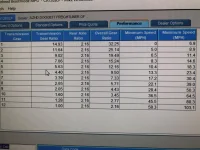
47433

12th gear allows me to travel in the recommended RPM range anywhere from 58 to 70mph. Below 58 and it will begin downshifting into 11th.

11th gear will allow me to run at speeds between 46 and 57 in the recommended RPM range.

Speeds on the far right are where the governor kicks in (1900 RPM). Safe to say, will likely never see 103mph, but it's nice to know it exists, LOL.
 
you realize that's almost the same gears as a 13 speed, without the 8th hole overdrives.

I'd want to know where the powerband is in the sweet spot and what those speeds are. IE, the Series 60 was between 1450-1700. You could take it down to 1300 easily though.

The DD15 I drove, drop those numbers almost 250 RPM. Coupled with the 13, it was a great combo. But behind a 10 speed, it absolutely sucked. The bands didn't match.
 
Last edited:
I'd want to know where the powerband is in the sweet spot and what those speeds are. IE, the Series 60 was between 1450-1700. You could take it down to 1300 easily though.

975-1300. 975 is where it reaches peak torque, as opposed to 1400 for the Series 60. DD series holds that peak torque through 1250 before it begins to drop. Basically, it has a long flat line, as opposed to the short hump the series 60 has.

Best Driveability is supposed to be 1100, up to 1300.

To compare, 975 is the equivalent to 1400 with the series 60.
 
The DD15 I drove, drop those numbers almost 250 RPM. Coupled with the 13, it was a great combo. But behind a 10 speed, it absolutely sucked. The bands didn't match.

Last one I drove, the peak RPM was 1300, cruised really well at 1350. Downspeeding the engine has pulled that peak RPM all the way down from 1300 to 975.
 
I think I will like the DT12 Transmission quite a bit.

View attachment 47433

12th gear allows me to travel in the recommended RPM range anywhere from 58 to 70mph. Below 58 and it will begin downshifting into 11th.

11th gear will allow me to run at speeds between 46 and 57 in the recommended RPM range.

Speeds on the far right are where the governor kicks in (1900 RPM). Safe to say, will likely never see 103mph, but it's nice to know it exists, LOL.
I thought that transmission was supposed to be overdrive in 12.
 
What's the startabilty look like with that tall of rear? Low gear doesn't look all that low considering that final drive?

Last I saw Detroit recommend specing 1300 @ 65 for economy and 1400 for performance?

As for drivability. It seems happiest between 1200-1400 in the higher gears, but does pull fine from peak coming up thru the gears. Driveline gets a little noisy from torsional vibrations below 1200 @ steady speeds. When I need it to really come alive, a split lower than normal gets it to 1400-1600, where it pulls hardest. The only time the rpm gets above 1600 is to wake up the Jake.

I'll see if I can't get a vid later after I get reloaded.
 

Back
Top