Duck Pond Redneckery


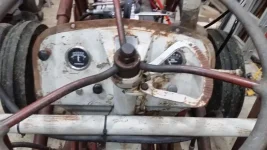
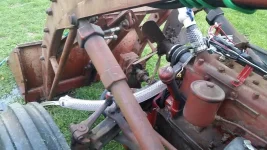
Amps and oil pressure. That's all old Henry thought it needed. o_O

20170509_215533.webp

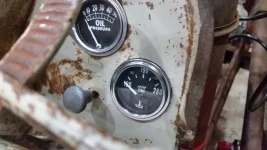
Hadda fix that.. ;)

20170509_224851.webp

Not a hunnerd percent sure how I'm gonna hook it up to the engine yet.. :toothpick:
 
Amps and oil pressure. That's all old Henry thought it needed. o_O

View attachment 40290

Hadda fix that.. ;)

View attachment 40291

Not a hunnerd percent sure how I'm gonna hook it up to the engine yet.. :toothpick:
did it come with a sensor for the head or block?

does the engine or block come with plugs, that can take the adaptor?

somme temp gauges are mounted inline with a hose, either by using the included temp sensor, mounted into an opening, or some have a submersible (wire like) sensor that can be used.
1/8" pipe thread sensor. The electric kind, not the retarded capillary tube type.

Aftermarket heads for these tractors have a spot right by the upper hose outlet where you can drill and tap for a sender but mine doesn't.

I got online and googled up some pictures of what the head looks like on the bottom and determined I'd render it weak and likely to crack if I drill it anywhere the sensor could access water.

So I'm gonna make a hose adapter thing. Steel tube that splices into the upper hose between the head and thermostat (which is inside the hose, because old Henry didn't believe in thermostats either) with something welded to it.

Can't use a nut like I did on the intake tube for the ether port because it has to be tapered pipe thread.

Probably just find a suitable chunk of steel and weld it on the pipe, and tap pipe threads into it.

Or order one online...


exactly what i had suggested. you can use steel tubing, but then you'd need to think about rusting.

i would be wondering IF you can use a steel tube, THEN install a pvc pipe inside of that. seal up the seams, then too, coolant will make its way thru the 2 pipes sooner or later, maybe at the senor location.

copper pipe may be better, but that can cost a bundle. and you may not get the diameter you'll need for flow.
 
exactly what i had suggested. you can use steel tubing, but then you'd need to think about rusting.

i would be wondering IF you can use a steel tube, THEN install a pvc pipe inside of that. seal up the seams, then too, coolant will make its way thru the 2 pipes sooner or later, maybe at the senor location.

copper pipe may be better, but that can cost a bundle. and you may not get the diameter you'll need for flow.
Eh,.. Plasti-dip or flex seal.

I'll hafta look at the labels on the can to see if they can handle the temperature.


Or I can just make it out of aluminum and braze it. I happen to have a bunch of 1-1/2" aircraft aluminum tubing.

That would be easier because I can just make the threaded port out of a solid chunk of aluminum too.
 
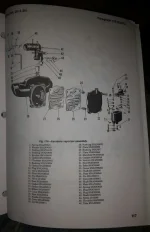
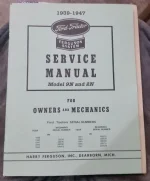
The reprint of the original service manual I ordered showed up in the mail today.

20170510_182020~2.webp

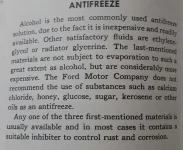
This paragraph made me spit coffee all over the floor in the shop.

20170510_181515~2.webp

:rolllaugh3:

This was written in 1947. They wouldn't have printed that if they didn't actually expect farmers to fill their radiators with honey..

I wonder if that was ever a common practice..
 
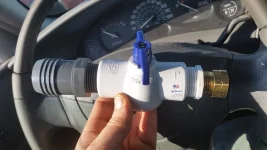
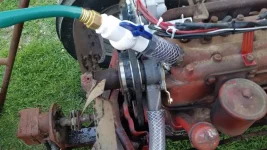
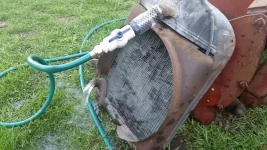
Radiator flush kits are designed to connect to heater hoses.

Obviously the tractor ain' got no heater.

So I had to adapt. ;)

20170512_173713.webp

The putting the large valve before the reducer cost an extra $2 but the smaller ones looked too restrictive.

Based on the fact nothing but a slow drip comes out of the drain on the engine block, and nothing at all comes out of the one on the bottom of the radiator, I think it's full of sludge or sediment.

I've changed the antifreeze a few times but never actually flushed it.
 
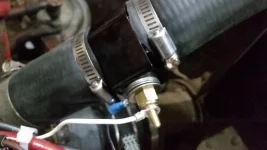
Water temp thingy. Had to improvise a ground. Sensor is supposed to be threaded into the head, not in the middle of a piece of rubber.

20170512_205812.webp

Yeah it's tapered pipe thread and I hadda put washers in there.

Three washers and ring terminal and it was really tight in the threads before it was tight in the washers.

Four washers and it would tighten down the washers before there was much resistance in the threads.

Had to put 2 star washers in there so they'd serve as springs. o_O

Took me a bit to figure out why the gauge wasn't working.
 
I think the sensor wire is frying my electrical system though.

Before I did that I had 14.49 volts across the battery running.

Now the voltmeter goes totally ape shit.

I removed the alternator wire to eliminate a bad voltage regulator.

Nope, still does it.

Removed the power wire to the water temp gauge, still does it.

I don't even have to hold the + probe to the battery and it goes nuts.

Tried two different meters too. Same thing.

:dunno:

All I can think of is some kind of induction going on in the low voltage wires that I've got zip tied up with the ignition wires.

Ain't no other way to route them.

Maybe rewire all the low voltage crap with shielded wire? :confused-96:

8 gauge for the alternator, 16 gauge for the coil, 16 gauge for the EI module, 18 gauge for the water temp sensor.
 
I disconnected that temp sensor wire at both ends.

Still crazy readings on the battery.

Cut all the zip ties and moved the low voltage wires away from the ignition wires. Still doing it.

In fact, just holding the multimeter near the engine block while it's running makes it go nuts.

This thing is a serious danger to people with pacemakers. :stare1:


Only high voltage can create that kind of energy.

So I shut er down and probed the ignition coil.

Battery voltage with electronic points open, 9 volts closed. It's supposed to be about 6.

Both resistors show half an ohm like they're supposed to.

Coil's gotta be fried or something. :dunno:

If that's the case, then the mystery is why it still runs. :confused:
do you have good ground.>?? more than one ground.>???
 
do you have good ground.>?? more than one ground.>???
The heavy iron is grounded via 4 "ahht" cable via ring terminal on one of the starter bolts.

The dash panel is grounded via 10 gauge wire to a ring terminal and a star washer under a 5/16" bolt on a spot I wire wheeled to bare metal and covered with dielectric grease.

If the heavy ground on the starter was bad it would melt that 10 gauge wire... Probably.. Well I dunno cuz since I rebuilt the carb (the 2nd time) it only needs to crank for a second before it starts.

Except for one occurrence yesterday I cranked it for about ten seconds before realizing the key was off.
 
A grounding issue on the low voltage side wouldn't explain the 9 volts I'm seeing at the top terminal on the coil when engine is off.

Something is up with the ignition coil. It's the only possible explanation.

I bet if I pull it off and probe it, it'll be less than two ohms. It's supposed to be 3.

Methinks water got into the crappy non-sealing gasket between the coil and the distributor when I yanked the lower radiator hose off yesterday.

Probably shorting the high voltage to the low, might be cured by drying it out. Who knows.

The tractor's punishment for misbehaving again is to remain locked in the barn in solitary confinement with no food and water for a few days. And definitely no sugar or honey for it's radiator.
 

Back
Top