
You are using an out of date browser. It may not display this or other websites correctly.
You should upgrade or use an alternative browser.
You should upgrade or use an alternative browser.
Duck Pond Redneckery
- Thread starter Duck
- Start date


mndriver
curmudgeon extraordinare
As much redneckery as you do this is the first time you've made plug wires?? You can use regular plain old ordinary wire strippers on spark plug wires

Duck
Sarcastic remark goes here
I did this little customization in case it still gives me crap in freezing temps next winter.
This is the intake tube between the air cleaner and carb.
It's a bitch to get off the carb because the exhaust is in the way of pulling it straight out. You have to disconnect it from the air cleaner then tilt it outwards to get it off the carb. And it's extremely difficult to get it off the air cleaner without taking the hood off.
So I drilled a hole in it, welded a nut over it, shortened a bolt so it won't obstruct the airflow, and made a little rubber washer to keep rain out.
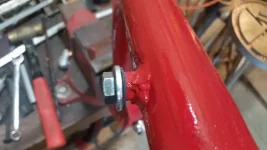
Little easy access port for spraying starting fluid in.
This is the intake tube between the air cleaner and carb.
It's a bitch to get off the carb because the exhaust is in the way of pulling it straight out. You have to disconnect it from the air cleaner then tilt it outwards to get it off the carb. And it's extremely difficult to get it off the air cleaner without taking the hood off.
So I drilled a hole in it, welded a nut over it, shortened a bolt so it won't obstruct the airflow, and made a little rubber washer to keep rain out.
Little easy access port for spraying starting fluid in.
Last edited by a moderator:

before that it came from chinaOk so I ordered new distributor end spark plug wire terminals from Summit Racing..
Just got an email with a tracking number.
The point of origin is Sparks, NV.
Seriously.

Duck
Sarcastic remark goes here
Well the doggone flippin' piece of history wouldn't start after all of that.
Had spark, had gas, wouldn't fire even with ether.
I took the distributor off. The cap is labeled counter-clockwise 1-2-4-3 and the front cylinder is #1. There's no way to put the rotor on wrong but the distributor shaft is like a flat-head screwdriver going into a slot in the end of the camshaft and I had it off, .... just in case the engine was cranked over 180 degrees while I had the distributor off, I rotated the engine by hand with my thumb over the #4 spark plug hole and when I felt the compression stop and the suction begin, I knew it was at or near TDC between compression & power stroke so that's when #4 should get it's spark, .... and the rotor was pointed at the #4 terminal on the distributor so that's all correct.
So it's a total mystery.
But I have a theory.
Though it has spark, it may be too weak.
When I'm checking for spark, it's with the spark plug out, and resting on the head, looking at the 0.025" spark plug gap while I crank the starter.
It requires 22,000 volts to spark.
Typically the input voltage on a coil should be battery voltage with points open, half that when closed. This electronic ignition module is basically the same as points.
I get 12.42 volts at the top of the coil, then I cranked the engine by hand a little bit and it dropped to 1.8 volts.
This is with both the Ford resistor and the additional one for the 12 volt kit, using the old 1 ohm, 6 volt coil. One resistor feeding the other in series.
So I'll try bypassing one of those resistors or just put the 12 volt 3 ohm coil on it and wire it straight to the ignition switch.
It could have spark in open atmosphere but not when it's under compression.
A Jacob's ladder works on that principle.
It's two parallel rods, except they're slightly further apart at the top. A high voltage power supply makes the electricity arc between the two rods at the bottom where they're the closest, then the heat from the arc thins the air immediately above it. Electricity flows better in thinner air. So the arc climbs up the two rods until it reaches a point at the top where the gap is simply too much even with the heated air and it begins again at the bottom.
So it'll take more juice to create a spark in a pressurized environment like in the cylinders. No idea how many psi I get but it's enough to blow my thumb off the hole when I'm running the starter.
So Friday I think it'll be, when those terminals arrive I'm going to try bypassing one of those regulators with an alligator clip jumper wire and see if it'll run.
If not, ... the tractor is still safe because I still haven't found my sledge hammer.

Tazz
Infidel
Didn't you put it under the table leg to stop the wobble??I still haven't found my sledge hammer.
Duck
Sarcastic remark goes here
No.Didn't you put it under the table leg to stop the wobble??
The last place I remember seeing it, was in a place I knew where I'd be able to find it later.
Tazz
Infidel
Well it is right there thenNo.
The last place I remember seeing it, was in a place I knew where I'd be able to find it later.

No not there right ***ing there

No not there right over .....oh FFS nevermind


ironpony
Professional Pot-Stirrer
Hook th' coil to yer johnson, and then crank it.Well the doggone flippin' piece of history wouldn't start after all of that.
Had spark, had gas, wouldn't fire even with ether.
I took the distributor off. The cap is labeled counter-clockwise 1-2-4-3 and the front cylinder is #1. There's no way to put the rotor on wrong but the distributor shaft is like a flat-head screwdriver going into a slot in the end of the camshaft and I had it off, .... just in case the engine was cranked over 180 degrees while I had the distributor off, I rotated the engine by hand with my thumb over the #4 spark plug hole and when I felt the compression stop and the suction begin, I knew it was at or near TDC between compression & power stroke so that's when #4 should get it's spark, .... and the rotor was pointed at the #4 terminal on the distributor so that's all correct.
So it's a total mystery.
But I have a theory.
Though it has spark, it may be too weak.
When I'm checking for spark, it's with the spark plug out, and resting on the head, looking at the 0.025" spark plug gap while I crank the starter.
It requires 22,000 volts to spark.
Typically the input voltage on a coil should be battery voltage with points open, half that when closed. This electronic ignition module is basically the same as points.
I get 12.42 volts at the top of the coil, then I cranked the engine by hand a little bit and it dropped to 1.8 volts.
This is with both the Ford resistor and the additional one for the 12 volt kit, using the old 1 ohm, 6 volt coil. One resistor feeding the other in series.
So I'll try bypassing one of those resistors or just put the 12 volt 3 ohm coil on it and wire it straight to the ignition switch.
It could have spark in open atmosphere but not when it's under compression.
A Jacob's ladder works on that principle.
It's two parallel rods, except they're slightly further apart at the top. A high voltage power supply makes the electricity arc between the two rods at the bottom where they're the closest, then the heat from the arc thins the air immediately above it. Electricity flows better in thinner air. So the arc climbs up the two rods until it reaches a point at the top where the gap is simply too much even with the heated air and it begins again at the bottom.
So it'll take more juice to create a spark in a pressurized environment like in the cylinders. No idea how many psi I get but it's enough to blow my thumb off the hole when I'm running the starter.
So Friday I think it'll be, when those terminals arrive I'm going to try bypassing one of those regulators with an alligator clip jumper wire and see if it'll run.
If not, ... the tractor is still safe because I still haven't found my sledge hammer.

You'll know fer sure what kind of spark yer gettin'!
Duck
Sarcastic remark goes here
Nah.Hook th' coil to yer johnson, and then crank it.
You'll know fer sure what kind of spark yer gettin'!
ironpony
Professional Pot-Stirrer
WussNah.

don't encourage him we'll have another thread on what kind of spark he's gettingHook th' coil to yer johnson, and then crank it.
You'll know fer sure what kind of spark yer gettin'!

Duck
Sarcastic remark goes here
I decided to take the loader hydraulic tank and suction lines apart and clean it all out hoping to solve the problem of it not working in freezing temps. Plenty of hydraulic systems work just fine in the cold. Snow plows, etc.don't encourage him we'll have another thread on what kind of spark he's getting
Anyway there's about an 8" section of rubber radiator type hose between the bottom of the oil tank and the steel line that runs up to the pump. It's so old I figured it'd probably crack when I remove it.
So I went to Farm and Fleet. They didn't have it so I went to Menard's.
$5 for a piece of chemical resistant braided clear vinyl hose,.... and $46 on trail mix.
And a big bag of salted elephant grade peanuts in the shells.
Sarah immediately stole the honey roasted peanuts when I got home.

I'd go back for more but they close in 4 minutes.


Rodger
Well-Known Member
Water in your hydraulic fluid? It doesn't take much and your hydraulic system will get real jerky in cold conditions. We used to run our tractor in and out of our warm shop to feed cattle in the winter. The condensation would build up and you wouldn't notice it on the dipstick, but there was enough in there to gel up the hydraulic fluid.
Duck
Sarcastic remark goes here
Well this tractor came with the farm.
It was under 30 inches of dust and lead paint chips.
There was aluminum foil over the top of the filler tube on the hydraulic tank. I think the missing cap also had a dipstick.
Big old foot long crack on the left side of the engine block.
One day I dragged it out & aired up the tires and towed it 1/4 mile up the street to the metal fab shop and had him weld up that crack.
It sat outside his shop through an entire spring rain season and wind blew that foil cap off.
So when it was welded up we towed it home and I got it running.
Hydraulics didn't work at all so I changed the fluid.
The only drain on that system is to remove the rubber hose from the pump. But it's the lowest point on the system.
The oil came out tan colored like coffee with lots of creamer.
So I filled it up, ran the bucket up and down a few times, drained it, and it was just as bad.
Two more times at 50 bucks each (5 gallons of universal hydraulic oil ain't cheap) and it was still coming out tan colored but it was working OK so I said fuck it.
I changed it again in 2014, same thing.
In cold temps, what happens is oil can't get to the pump.
I made a new filler tube and cap, using a Milton male coupler on the end of the vent so I can blow air into it using a female coupler and a two foot hose.
Just pressurizing it with my mouth used to get it working but eventually it got so I would have to put 20-30 psi into it before it would work.
The only way to heat the oil is to install a radiator hose type engine heater and hope the oil can disperse heat fast enough not to burn the oil. That's why dipstick heaters aren't good.
The reservoir is pot metal or aluminum. All I know is it's painted, looks like crap and magnets won't stick to it.
I'm just gonna take the top off the reservoir and see what it looks like in there, clean it out, and remove the long steel tube and pull a kerosene soaked rag through it with a wire.
If the tube is that bad I'll figure out a way to cap one end of it and leave it full of kerosene overnight.
I'm not worried about the high pressure side of the system.









Similar threads

- Replies
- 7
- Views
- 63

- Replies
- 12
- Views
- 48

- Replies
- 0
- Views
- 6
