Duck Pond Redneckery


a simple light bulb, using a 12v socket, much like a tail light.......

it will "strobe" on the firing of number one cylinder....

obviously, as smart as you are or claim to be, you thought you'd discount what i had suggested, as even @Duck (and maybe a few other gear heads) would have known how this could be done.....

you may now go back to your desk jockey's job....
Skateboard is right.

There's a mark on the crankshaft pulley of a car engine and a little stationary mark on the timing cover.

They happen to line up right when the #1 cylinder is top dead center and is supposed to get it's spark.

A timing light senses the high voltage in the spark plug wire and triggers an instantaneous flash of light and because it's just an instant flash, you can see precisely where the mark on the pulley is relative to the stationary marks on the timing cover and you adjust accordingly.
you can still do it the "static way", i believe it is called, with the engine off....you say you have no marks on the crank pulley, but you can still remove the number one spark plug, put your finger on the hole, crank with maybe quick bursts on the starter button, OR, using a socket wrench on the crank pulley bolt. then at least, you have "some" point to start with, with the cylinder being at TDC. it may not be perfect, but it can be done. there may be a mark on the crank pulley, but either it's very tiny, or worn down from the constant blasting of debris from farming all those years.
 
That way only gets it sort of close. Without the engine running there is no vacuum or dwell and it's usually off from top dead center and so on and so on
 
That way only gets it sort of close. Without the engine running there is no vacuum or dwell and it's usually off from top dead center and so on and so on
i already said it would not be perfect, i did say it would be close, but i proved...to you..it can be done....

i am satisfied, that you found that i was not BS'ing.......and you LOST your debate.

and he has electronic ignition, dwell would be incorporated into that...
 
and @Duck , here's another way to check for a near close timing.....


to "ensure" your engine is at TDC, you could insert a tall pencil (or long thin wooden dowel) into the number 1 spark plug hole and watch the pencil (or dowel) rise as you approach TDC..when it starts to go back down, stop, go back a tiny bit till it's at the top again...

there are "timing wheels, that are magnetic, once you find TDC, then you can set the timing wheel to zero, you can from that point, maybe file a small mark as zero, then by using the timing wheel, you can mark off, 2, 4, 6, 8 and so on, degree's of advancement....

remove the timing wheel......
 
i already said it would not be perfect, i did say it would be close, but i proved...to you..it can be done....

i am satisfied, that you found that i was not BS'ing.......and you LOST your debate.

and he has electronic ignition, dwell would be incorporated into that...
He didn't lose this debate.

A car tail light bulb simply doesn't blink on and off fast enough. It has to be a strobe, or possibly an LED.

My tractor has no timing marks. I know this because I cleaned the grease off of the front of the engine looking for the stationary marks and they don't exist. Not even a threaded hole where something might have been. Timing is set with the engine off, through trial and error.

It can't be adjusted while running either because you simply can't get to it without removing the fan. And radiator. Or at least the belt. Same belt that runs the water pump. And without a timing light you have to set it so it runs right under load, warmed up.
no he lost..i did mention "static timing", which the video does back up what i had said. i said a 12 volt light bulb can be used, the video showed i was right.

a strobe light is used for the running of the engine, of course, but he clearly denied my posting as being possible.

now, i was viewing yet another video, this too was another VW engine, and the guy shows where the crankcase halves come together and the "seam" is zero..i looked at this pic of yours..

20170324_173644-jpg.39545


i was looking for a "seam" in the block that may have been used to set the timing, i didn't see one. i can see how small that crankshaft pulley is, so a timing wheel may not be of use, unless they come in smaller diameters. there could (have been) timing marks on the block, either above the distributor or below for "static timings', but you got so much cakked on dirt, i cannot see.

all i did, as i re-read my posting, i said "strobe" when i should have said..."flash" as the number one plug fires.

but semantics aside, i was STILL RIGHT, that a 12 volt light bulb can be used......he said, no it cannot not......
 
Last edited:
I scraped all that stuff off after putting the distributor back on so crap wouldn't get into that hole. Then I used degreaser and a rag. No marks.

It's a stone age engine.

Timing probably isn't that critical anyway. Low compression, low RPM. Mechanically it's basically a 4 cylinder version of a 5 hp Briggs and Stratton off a snowblower.
i too was of the thinking, low rpm's, no speed to speak of, timing only has to be close. plus there will be worn parts, you may not even get better than "close"
 
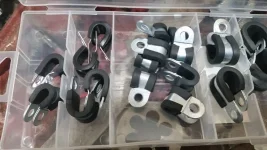
Problem.. Trying to drill these open to fit under a 3/8" bolt is just asking for broken drill bits. They don't have any at Farm and Fleet either. Just for 1/4".

20170413_211503.webp

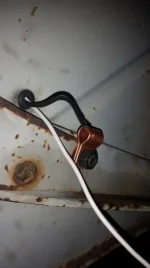
Solution. Make my own out of flattened copper tubing, bent around a 3/8" bolt.

20170413_211526.webp

Gotta make 12 of these. I'm rewiring the lights on the tractor.

20170413_211549.webp

There isn't one inch of original wire anywhere on this tractor. I'm redoing it all. I re-did the orange blinky last night.
 
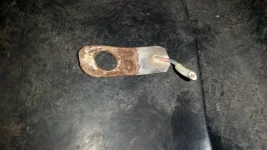
Prehistoric ring terminal.

Just a wire soldered to a piece of copper.

20170414_000645.webp

It's what was grounding the fenders on the tractor.
 

Back
Top