the animal rescue people ought to take that dog away from him. imagine, endangering an innocent animal.

the animal rescue people ought to take that dog away from him. imagine, endangering an innocent animal.

the animal rescue people ought to take that man away from the dog. imagine, endangering an imbecile.


That could be, Air is thinner when it is hot. That could play into the engine but I know for sure that is plays on the lift on air over wings. Planes can climb much faster when the air is cold.Engines lose power on hot days. I learned that in a field near Elizabeth, IN when I was 13.
Neighbor had a plane, not much engine. We flew it there to visit his parents and landed in a pasture.
Hot day. When we left, we barely cleared the trees. Climb rate totally sucked too. We could barely maintain 80 kts at 500 fpm.
There were other factors like barometer and humidity but it's a fact they perform better in cold air, as long as it's not icing up.
On the truck, drawing in air from outside the engine compartment might help with efficiency in the summer.
Dunno... I mean there's that fan that runs constantly too. No clutch, just always spinning like on the tractor.
I wonder how much of a MPG boost I could get on the highway (and in winter) if I convert it to the modern type with a thermostatically controlled clutch so the fan ain't running when it's not needed.
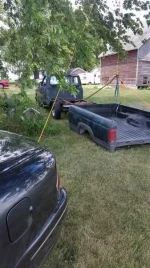
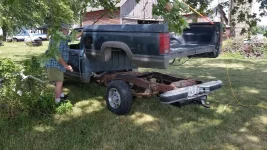
It's a 300-6 engine. They were made from 1964 to 1996. Certainly at some point they went to clutched cooling fans. The parts probably bolt right on to an older engine.

I know they did. The old orchard truck I sold for scrap (Dad let a tree grow through the damn thing) had a 300-6 with a clutch fan.Engines lose power on hot days. I learned that in a field near Elizabeth, IN when I was 13.
Neighbor had a plane, not much engine. We flew it there to visit his parents and landed in a pasture.
Hot day. When we left, we barely cleared the trees. Climb rate totally sucked too. We could barely maintain 80 kts at 500 fpm.
There were other factors like barometer and humidity but it's a fact they perform better in cold air, as long as it's not icing up.
On the truck, drawing in air from outside the engine compartment might help with efficiency in the summer.
Dunno... I mean there's that fan that runs constantly too. No clutch, just always spinning like on the tractor.
I wonder how much of a MPG boost I could get on the highway (and in winter) if I convert it to the modern type with a thermostatically controlled clutch so the fan ain't running when it's not needed.
It's a 300-6 engine. They were made from 1964 to 1996. Certainly at some point they went to clutched cooling fans. The parts probably bolt right on to an older engine.
Engines lose power on hot days. I learned that in a field near Elizabeth, IN when I was 13.
Neighbor had a plane, not much engine. We flew it there to visit his parents and landed in a pasture.
Hot day. When we left, we barely cleared the trees. Climb rate totally sucked too. We could barely maintain 80 kts at 500 fpm.
There were other factors like barometer and humidity but it's a fact they perform better in cold air, as long as it's not icing up.
What year was it?I know they did. The old orchard truck I sold for scrap (Dad let a tree grow through the damn thing) had a 300-6 with a clutch fan.
I should put JATO engines on the old pickup.In Thailand, they used to spray down runways used by Air Force bombers with liquid nitrogen to cool the runways and the air just above the ground enough to get missions to Hanoi off the ground.
I should put JATO engines on the old pickup.


The Arizona Highway Patrol came upon a pile of smoldering metal embedded into the side of a cliff rising above the road at the apex of a curve. the wreckage resembled the site of an airplane crash, but it was a car. The type of car was unidentifiable at the scene. The lab finally figured out what it was and what had happened.
It seems that a guy had somehow gotten hold of a JATO unit (Jet Assisted Take Off – actually a solid fuel rocket) that is used to give heavy military transport planes an extra 'push' for taking off from short airfields. He had driven his Chevy Impala out into the desert and found a long, straight stretch of road. Then he attached the JATO unit to his car, jumped in, got up some speed and fired off the JATO!
The facts, as best could be determined, are that the operator of the 1967 Impala hit JATO ignition at a distance of approximately 3.0 miles from the crash site. This was established by the prominent scorched and melted asphalt at that location. The JATO, if operating properly, would have reached maximum thrust within five seconds, causing the Chevy to reach speeds well in excess of 350 MPH, continuing at full power for an additional 20–25 seconds. The driver, soon to be pilot, most likely would have experienced G-forces usually reserved for dog-fighting F-14 jocks under full afterburners, basically causing him to become insignificant for the remainder of the event. However, the automobile remained on the straight highway for about 2.5 miles (15–20 seconds) before the driver applied and completely melted the brakes, blowing the tires and leaving thick rubber marks on the road surface, then becoming airborne for an additional 1.4 miles and impacting the cliff face at a height of 125 feet, leaving a blackened crater 3 feet deep in the rock.
Most of the driver's remains were not recoverable; however, small fragments of bone, teeth and hair were extracted from the crater, and fingernail and bone shards were removed from a piece of debris believed to be a portion of the steering wheel.


90 something. It was toast. I tried rolling the motor off the crank and it was locked up. Cost more money to fix it than it was worth.What year was it?
Mythbusters tried to recreate that. They fired three on the top of a Chevelle(?) in the salt flats. Never did take offThis may have been the best Darwin award ever.
And yeah, it's fake.
Ford used little tar pads here for some reason.

Testify brother!
The Dodge slant-six 225 engines were also bulletproof.
I dunno.Cheap shock absorbers? Silicon caulking may not hold up as well.


 MMMM...Carb Icing!