Blood
Driveler Emeritus
Did you know that hot welding slag landing on the crotch area of your coveralls/jeans can teach you to fly???
Everybody knows that.

Did you know that hot welding slag landing on the crotch area of your coveralls/jeans can teach you to fly???

Vise-GripHere's a question for all the rednecks, near rednecks and wannabe's amongst us.
What's your favorite tool in your collection? You know; the one that is most used, most versatile, wonder how you ever got along without?

Vise-Grip


you must be moving to commieforina as it looks like your building a smartfortwoView attachment 26948
The area under the gear selector is hollow.
If you look into that space, behind the yellow wire you can see there's some room in there.
View attachment 26949
Perfect place to put a car alternator. Then I'd have a self-propelled version of this homemade 12 volt generator I built about 15 years ago:
View attachment 26950
With internal voltage regulator, it's a very simple schematic. Just a switch to energize the field coils. With that switch off, alternator does nothing. Turn it on & it starts charging. That was a failed experiment though. That 3 horse engine didn't have enough power. When I turned on the trolling motor, the engine dogged down so much it died. Perhaps experimenting with different pulley sizes on the engine would've helped, but that engine smoked terrible too. It was totally worn out. And right now, it's seized. That thing could charge a deep cycle battery with no problem, and it powered a 1000 watt inverter that was running a eight 100 watt light bulbs. (yeah, .. my homemade load tester, .. bunch of 100 watt light bulbs, .. LOL) It just wouldn't run the trolling motor. At least not with that old junk car battery. With a couple deep cycles, it might've.
So here's what I'm looking at underneath the mower:
View attachment 26947
The pulley that used to run the blades is available but there isn't room for the alternator because the drive belts are in the way. But there's room for a shaft. Like if I made a crossmember to hold a shaft & a bearing, the shaft can direct-drive the alternator up above the floor pan, inside the tunnel, and not interfere with the drive belt. I could re-route the drive belt with idler pulleys easier than I could do that. It's not like it'll slow down the mower by having an extra bearing to spin .. but whatever...Maybe I'll do it that way.
Then there's this issue:
View attachment 26950
The mower's vertical shaft engine turns the same direction relative to it's cylinder as the one on the cedar generator. The reason I mounted the engine & alternator diagonally like that is so I wouldn't spin the alternator backwards. I knew which way the alternator had to turn by looking at the fins on it's cooling fan. It has to suck air outwards at the pulley. Air enters the back of the alternator.
I know if it was a generator, I'd get reverse polarity if I spun it backwards. But it's an alternator, ... it produces AC current and a rectifier converts it to DC. This particular 78 amp AC-Delco alternator has it's voltage regulator built in too, which is why I chose that particular alternator.
I'd have to pull the pulley off the armature in order to connect a coupler so I can put an extension shaft on there so the pulley can be located 10 inches away from the alternator body, ... it shouldn't be hard to get the fan off. I'm hoping the fan isn't permanently connected to the pulley. It would make the machining more complicated.
I'm gonna take a guess & say it'll work just fine spinning it backwards, ... as long as it can cool.
Gotta figure this out before I can proceed.

Maybe I should just put a heavy duty alternator out of an ambulance on the thing, eliminate the transaxle & put electric hubs & battery from a golf cart on it. Then it'll be a true hybrid. Even "greener" if I convert the engine to run on ethanol.you must be moving to commieforina as it looks like your building a smartfortwo
I just got done converting my old 300D to run off diesel and cng let me tell you whay a fucking difference that makes it now drives like a gasserMaybe I should just put a heavy duty alternator out of an ambulance on the thing, eliminate the transaxle & put electric hubs & battery from a golf cart on it. Then it'll be a true hybrid. Even "greener" if I convert the engine to run on ethanol.
 and I get 130 mpg lets see a prius do that
 . people who buy hybrids are idiots diesels are more flexible to convert over and better mpg. next i'll be doing my suv's
are you stealing my idea of a diesel hybrid LOL.I wonder how I'd have to configure that thing, and if I'd be better off just putting an engine & alternator on an electric golf cart.
Obviously the engine could idle when there's no load. Drive it around with the engine off for quite a while, ... but if the engine is idling, as soon as you take off the electrical load from the motor will dog down the gas engine when the alternator starts trying to cover the demand. So you'd have to manually bump the throttle up before stepping on the "gas" if the engine is running.
Maybe figure out what RPM the engine needs to run to reach bare-minimum RPM for the alternator to put out it's full capacity, but rig up a switch on the "gas" pedal, an additional switch that closes a pin-switch under the pedal so when you floor it, that pinswitch breaks the circuit that powers the alternator's field electromagnets. If the field magnets are not energized, the alternator is useless and won't dog down the engine.
So if you just want to put enough mechanical energy into the alternator to power the golf cart when it's just cruising along, but disable the alternator & use only the battery when accelerating under heavy electrical load, it would be an efficient hybrid. Well, ... efficient for what it is.
The thing about electric vehicles though is that they can have hub motors. One motor directly driving one wheel. Put one on each rear wheel & you basically have posi-traction.
No that's just how a lot of hybrids are set up.are you stealing my idea of a diesel hybrid LOL.
I was thinking of building a diesel hybrid where the diesel gen just idles even of the cars going 150 mph. and it would just generate power to keep the car going and everything in it running while sipping diesel. will they allow that here hell no why better fuel economy wich means less road taxes for them to spendNo that's just how a lot of hybrids are set up.
And I've been wanting some kind of hybrid outboard type of setup for my homemade rafts. I NEVER want to listen to a gasoline engine screaming away when I'm floating down the river, but I always worry about my deep cycle battery's state of charge & I'd like to be able to get drunk without having to constantly compute amp hours in my head.
The purpose for a hybrid drive on the raft is just so I can enjoy the silence, or at least not have a lawnmower engine making all kinds of noise when I've got the stereo going, but when we stop to hang out on shore for a while, I can take & carry (or drive) the 12 volt generator & batteries out into the woods & just run an extension cord back out to the shore to power the stereo. Get the batteries topped off then shut the thing off since the stereo can be loud as hell & still only draw about 4.5 amps. Or just leave the thing off & not fire it up until we have to drive the raft upstream a few miles at less than walking speed (relative to shore).
Yeah I just realized that the other night.Tool you can't live without? Air compressor and accessories... there is grinder, air hammer, etc etc.
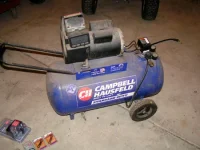

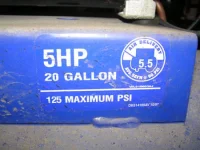

The motor I can understand. That high RPM pump is different though.18 years is pretty good for a non-commercial electric motor. I think you got your money's worth.
We tested fire hose by pumping it up to 300 psi and letting it sit there for 15 minutes. If it leaked, it failed. Normal use pressure was 125 psi.Most everything that can explode is rated by pumping it up until it does then cutting that max in at least 1/2 and sometimes 1/3.