
You are using an out of date browser. It may not display this or other websites correctly.
You should upgrade or use an alternative browser.
You should upgrade or use an alternative browser.
Duck Pond Redneckery
- Thread starter Duck
- Start date

Duck
Sarcastic remark goes here
No. In that particular picture, my only handywork was the caulk and the expanding foam.I thought that was a result of your recent handy work
If it was my handywork I wouldn't have said "crappy installation", I'd have blamed it on crappy materials made in China.

The windows only look "new" because we never peeled off the stickers.
Yesterday I did that. Had to use some varnish that used to be paint stripper to get the adhesive off.
Going to Menard's in a few minutes. Gonna take the Geezer's S-10 because it ain't been started in like 3 months.

Blood
Driveler Emeritus
This is after I sprayed vinegar on it. It was jet black, looked like it had been burnt.
Mold.
I'd have preferred bleach but vinegar was ten feet away and bleach is at the store.
Vinegar seems to have killed it.

I've got a recipe around here somewhere that will stop & prevent wood fungus and mildew as well as kill and prevent termites, ants, etc.
All that's in it is antifreeze, Borax & boric acid.
It's not even toxic if you use propylene glycol antifreeze.
The glycol is only an agent to get the Borax and boric acid into the wood because wood will soak it up like crazy.
They used to sell a product called Pinta (?) that was around $70 per gallon last time I checked which has probably been over 15 years.
It's probably outlawed by now.
I did a quick giggle...
Commercial:
Tim-Bor®: Solid sodium octaborate; dissolves in water to make approx. a 10% solution containing 6.6% borate (B2O3); about $13/lb. Covers about 200 sq ft.
Bora-Care®: 40% solution of sodium octaborate in ethylene glycol; 27% borate content; $90/gal. for the concentrate.
Home-Brew Water Solution of Borates:
Based on U.S. Navy spec. of 60% borax-40% boric acid (this ratio gives the maximum solubility of borates in water);
#1. This is equiv. to Tim-Bor®... 6 parts of borax and 4 parts of boric acid.
To prepare one gallon of a 10% solution, start with an oversize container (larger than 1 gallon ) add 1 lb. of powder to appx 3 qts of water agitating until the powder has dissolved, then add additional water to end up with 1 gallon of mix. To prepare a 15% solution, add 1.5 lbs. of powder, then add the remainder of the water and mix as previously. Approximately 1 gallon of solution will be needed to treat 200 square feet of wood surface area. (Note: solutions should be used immediately and not stored.) .
EXAMPLE: Prepare 5 gallons of 10% solution:
Add four (4) gallons of clear, warm water to a six-gallon bucket.
Add five (5) lbs. of powder while gently stirring.
Add enough water to bring the final volume to 5 gallons, and continue to stir until all of the powder has dissolved.
Agitate the solution briefly at the beginning of each spray job, or after the solution has been standing for an extended period.
Do not spray or spill onto soil or foliage.
Apply two applications of a 10% solution to wood surfaces by brush or spray. Apply one application of a 15% solution to wood surfaces by brush or spray. Applications may be made to wood structures including decks, fences, steps, sheds, barns and other out-buildings.
#2: This is equivalent to Bora-Care®
Prepare the concentrate:
Mix 1 Gallon glycol antifreeze, 4 1/2 pounds borax, 3 1/2 pounds boric acid.
Mix the ingredients and heat till boiling gently. Boil off water until a candy thermometer shows 260°F. This removes most of the water of crystallization in the borax.
This solution is stable at 40°F and has a borate content of 26%. This is equivalent to Bora-Care® at about $90/gal. for the concentrate. The concentrate must be diluted with an equal volume of water before being applied.
Application: Add 1 gallon of water to every gallon of concentrate and stir thoroughly until solution is completely uniform. Always use diluted within 24 hours after mixing. If kept for longer periods of time, the active ingredient can drop out of the solution.
Note: is toxic to plants and shrubbery; if necessary, cover plants, root systems and surrounding soil with plastic to avoid contamination. Apply only to bare wood. Remove any finish or water repellent coating before applying . Wood surfaces should be free of dirt and other contaminates. Apply diluted by spray or brush to all exposed wood surfaces. It may occasionally be necessary to apply more than one coat of to attain the recommended application rate. This is especially true for larger, smooth surfaced wood members. Wood surfaces should be allowed to dry for at least 2 hours between applications. Do not apply in the rain or snow. If inclement weather is expected, protect exposed treated surface with a plastic tarp for at least 24 hours after treatment. One gallon of concentrate will treat up to 800 board feet of wood. Only diluted should be applied to any wood surface. Prior to application, check wood surfaces for an existing water repellent finish by spraying a small amount of water onto the surface of the wood or logs. If the water beads up or is not absorbed into the wood, a finish is present which must be removed before applying the diluted solution.
LINK
Duck
Sarcastic remark goes here
This is the ONLY way to haul plywood.
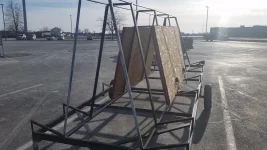
Use the flatbed carts in the store, park it beside the stack in the store and simply slide them across onto the cart two at a time.
Park the cart beside the airplane wing trailer really close so the edges overhang the edge of the trailer, grab 4-5 sheets and simply stand them up.

I split the stack in half simply to make it easier to strap down.
Use the flatbed carts in the store, park it beside the stack in the store and simply slide them across onto the cart two at a time.
Park the cart beside the airplane wing trailer really close so the edges overhang the edge of the trailer, grab 4-5 sheets and simply stand them up.
I split the stack in half simply to make it easier to strap down.

mndriver
curmudgeon extraordinare
That would be it.
And buy plenty of nomex suits and hoods when you spray that shit.
It comes out of the hair ONE way.
You cut it out.
Duck
Sarcastic remark goes here
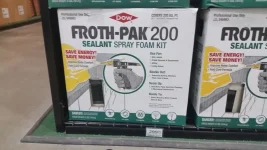
I'm not insulating with it. Just sealing the gaps behind the corrogations in the siding. I'll probably spend maybe $50 at the most for the cans.That would be it.
And buy plenty of nomex suits and hoods when you spray that ****.
It comes out of the hair ONE way.
You cut it out.
Duck
Sarcastic remark goes here
Stopping drafts doesn't require a lot of foam.we used it for spraying the rim joists on the house to stop drafts.
I think you meant to say insulating the rim joists themselves, because they're nothing more than an inch and a half of wood between the warm basement and the cold outside. Except for the siding, which might as well not even be there as far as heat retention goes.

Rigjockey
In Gord we trust!
Like Prono for pyros.When I moved my house a few years back, I got to torch the old farmhouse that was on the acreage. That sure fed the inner firebug for a while!
See what I did there? See it?
Never mind.
mndriver
curmudgeon extraordinare
Stopping drafts doesn't require a lot of foam.
I think you meant to say insulating the rim joists themselves, because they're nothing more than an inch and a half of wood between the warm basement and the cold outside. Except for the siding, which might as well not even be there as far as heat retention goes.
House was flow tested with NO improvements. 1250 CFM.
After the foam sprayed on the rim joist, 800 CFM
after the windows/doors, 680 CFM.
At 650, you are required to have an air exchanger installed.
It was a house built in 1903.
Duck
Sarcastic remark goes here
Flow test?House was flow tested with NO improvements. 1250 CFM.
After the foam sprayed on the rim joist, 800 CFM
after the windows/doors, 680 CFM.
At 650, you are required to have an air exchanger installed.
It was a house built in 1903.
What, they hook up a big blower fan to a window and close all the others and try to implode the house?
mndriver
curmudgeon extraordinare

AK7
Well-Known Member
Those are great numbers.House was flow tested with NO improvements. 1250 CFM.
After the foam sprayed on the rim joist, 800 CFM
after the windows/doors, 680 CFM.
At 650, you are required to have an air exchanger installed.
It was a house built in 1903.
mndriver
curmudgeon extraordinare
Those are great numbers.
I paid for it too. Almost $19,000 worth of home improvements.
Rim joist,
Roof
HE Forced air furnace and 10 SEER Central air.
Window inserts, Doors
R50 Insulation in the attic.
We lowered our monthly heat bill from a budgeted $250 / month to $48/ month.
Blood
Driveler Emeritus
I paid for it too. Almost $19,000 worth of home improvements.
We lowered our monthly heat bill from a budgeted $250 / month to $48/ month.
That's still only about 8 years to break even.
mndriver
curmudgeon extraordinare
for capital investments like that, 7-8 years is reasonable.
This was the actual program that I was a part of. I had just returned to college and the intention was to live in Fargo for 10 years. We moved after the 8th year, so I had to pay back $10,000 of the $15,000 grant we received.
Fargo Housing Rehab - City of Fargo
We also updated the old 60 AMP fuse electrical box which had the entire house on 4 circuits to a 200 amp circuit breaker box with 20 circuits.
They have changed the program since I was in it.
when I was part of it, after the 8th year, 1/3, 9th, 1/3 and 10th year 100%. Cap was $15,000
This was the actual program that I was a part of. I had just returned to college and the intention was to live in Fargo for 10 years. We moved after the 8th year, so I had to pay back $10,000 of the $15,000 grant we received.
Fargo Housing Rehab - City of Fargo
We also updated the old 60 AMP fuse electrical box which had the entire house on 4 circuits to a 200 amp circuit breaker box with 20 circuits.
They have changed the program since I was in it.
If the property is sold within the first 3 years, 100% of the loan must be repaid. 10% of the loan will be forgiven if the home is sold in the 4th year, and an additional 15% will be forgiven each year thereafter (years 5-10).
Total assistance cannot exceed $24,500 and will be determined based on each property’s needs.
when I was part of it, after the 8th year, 1/3, 9th, 1/3 and 10th year 100%. Cap was $15,000
Last edited:
Duck
Sarcastic remark goes here
Note the OSB scraps closing the gap between the post and the steel siding.
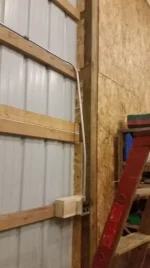
That gap won't matter once the wall is done but it's sure as hell making a difference now.
I noticed cold air coming out of the gap and freezing my hands when I was putting that outlet there.
It's all airtight back there though.
Mystery.... for about ten seconds..
Hot air expands, cold contracts.
The insulation doesn't touch the steel.
Hot Air up high was expanding into the gap, going between the insulation and the steel, thus pushing freezing cold air back into the shop down low.
Therefore the entire south wall I've insulated so far wasn't helping anything.
Temperature shot up ten degrees near the wall after I did that, and the furnace which has been running almost continuously all day, has been off for like 20 minutes and counting.





Similar threads

- Replies
- 7
- Views
- 63

- Replies
- 12
- Views
- 48

- Replies
- 0
- Views
- 6
