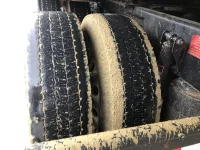
I got the wrong tires on the new truck


I was digging through the spec sheet this week, and realized that I totally overlooked what model of Michelin's I got for my drives, and found out that it is too late to change.

The tire I wanted was the X-Line Energy D, though they now have a D+ which is supposed to be even more fuel-efficient. Being a brand new tire model, not sure I want to risk it, so best to let others test that tire and go with the D.

Instead, the tires were the XDN2. These have a little higher rolling resistance. On the plus side, they have a higher life expectancy and better traction in bad weather.

In the end, factoring in a slightly higher cost for the X-Line Energy D, and higher life for the XDN, it looks like I am potentially losing just over $600/year with the XDN2's. That said, a decent portion of that rolling resistance is caused by the deeper tread on the XDN2, so that cost should drop over time as the tires wear down. I get that latter part from other's experiences with the tires, stating they ended up with virtually the same MPG as they had with the Energy D's after running the tires for a while.

I guess time will tell, because it is doubtful I will be making a change. To do so, I have to see what the local tire dealer will do in regards of buying takeoffs (which will cost me money) and the labor of mounting a new set of tires.

The XDN2 is not a smartway verified tire, but if I am reading the CARB communist manifesto properly, you only need smartway tires on the tractor if it is something like 2014 or older.

Anyhow, from Michelins calculator for the two tires, I am attaching a PDF
Could be worse.

The only way a Cascadia is an "EPA smart way certified" tractor is if they come with Continental tires.

Walmart told us were not so interested in EPA Smartway stuff so as soon as the Continental become worn we go back to our Michelin XD series.

Those Continental are pure garbage. About on the level of Kelly.

Maybe recapped as trailer tires but as drives they're like the wide based singles. Constantly feels like the ass of the truck is sliding around.
 
Spoke to the folks at Michelin today. As for pressure, they advised bumping the pressure 5-10 over the weight rating needed for load shifting in curves and such.

Went further to say that there should be no wear concern if running then at max pressure, other than a potentially rougher ride. Said to monitor the wear to be sure, but basically the more pressure the lower the rolling resistance.

As for difference between the XDN2 and the Energy D, it would be somewhere around .1 difference in the beginning, and after a little wear they are very similar. Time will tell I guess as I will likely keep these tires.
 
Spoke to the folks at Michelin today. As for pressure, they advised bumping the pressure 5-10 over the weight rating needed for load shifting in curves and such.

Went further to say that there should be no wear concern if running then at max pressure, other than a potentially rougher ride. Said to monitor the wear to be sure, but basically the more pressure the lower the rolling resistance.

As for difference between the XDN2 and the Energy D, it would be somewhere around .1 difference in the beginning, and after a little wear they are very similar. Time will tell I guess as I will likely keep these tires.
At least they look manlier.

The Energy D look like what every FWD crossover has.
 
Sounds like something you were already told yesterday. 😏
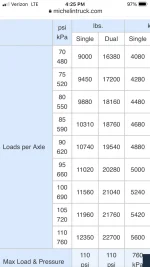
It's what I have always done, but I got curious after looking at Michelins load inflation table.

That said, I've read up on people running the tires, and with overinflation, they experienced the heal/toe wear. That has always been chalked up to the fact that the engines have so much more torque, but the ones I read said that dropping the pressure back down to where it was supposed to be took care of it.

So, I guess I will split the difference. Instead of running 110 like I have done for a while now, I am going to drop to 90-100, haven't decided where yet.
 
95 was working quite nicely and I’m trying 90psi now.

BBC50A0F-C47C-4E31-90D5-FBB768A4E49F.webp


It’s still up from the 75 psi that Michelin says you can run for a 34,000 tandem load.

8EF7D8F8-22AB-46B2-8241-65F8DAC0FEF5.webp
 

Back
Top