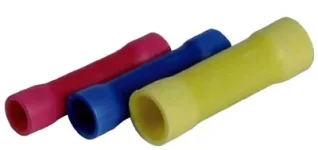
When you buy a head unit, it typically comes with a wiring diagram. You get a wiring diagram for the vehicle you're installing it in, and there you have it. Done it many times over... not a whole lot to it. Just make sure you get your butt connectors on there properly and that they're the right size.
There isn't much wire to work with. I'm sure you've had to use a wire stripper on a wire that's barely able to reach out through the hole in the dash and there's no room to get the stripper in there. The reason you don't cut the vehicle's wires is basically because you'll run out of wire eventually, like if the one you're putting in takes a crap & you gotta replace it. You'd lose 1/2" of wire when you cut the butt connectors off.
What I've done, with older vehicles they don't make adapter harnesses for, is when I cut off the factory plug end, I'll use bullet connectors or blade terminals with the rubber boot over the male ends. That way if I have to replace the stereo again, I don't have to cut any more of the vehicle's wire off. I simply pull the male & female bullet or blade connectors apart & re-use the old ones on the vehicle's wires & use new ones on the new stereo's wires.
On a DC circuit, if you are using disconnects, there are two types. Bullets and blades.
Bullet connectors:
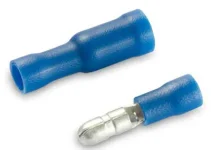
On a DC circuit in which the electricity only flows in one direction, if you are using bullet connectors, the female should be on the end of the supply wire and the male should be on the receiving end. If they come apart, the female connector has the insulator material around the electrode part so it won't spark when it falls onto something grounded. The male end should be on the wire that will have no power in it when the connection comes apart.
Blade terminals:
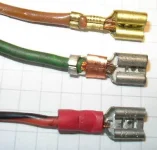
Above: standard female blade terminals
Below: standard male blade terminal
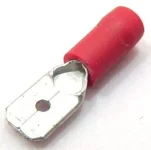
There are a variety of types of blades. Some are insulated, others aren't. Don't use them if both the male & female are not insulated unless you want to wrap them up with electrical tape when they're plugged into each other. Below is a insulated female blade terminal. It can be used with a non-insulated male.

Below is a insulated male. It can be used with a non-insulated female.
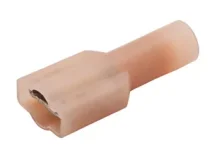
Some of the insulated types have both the male & female insulated & they're designed so the insulation of one slips over the insulation of the other. All you gotta remember is that when the two connectors are disconnected, the one with the insulation around it should be the one that has power and the bare one should be on the wire that will not have power in it when the connection is broken.