Electric Chicken
Well-Known Member
I don't believe those are CARB compliant.


You do realize that since the spiders are after the ring and pinion, that for two trucks moving across the same terrain, the forces on the spiders would be the same no matter what ratio was in front of them?Do use know differentials work?
Think of it like a pipe wrench
Weeny 3.36s need a lot of power (long pipe wrench) to turn
3.70s use less power (short pipe wrench) or less power
The little spider gears in diffs don’t handle big power (long pipe wrench) when use are off road so use use high rpm to keep use out of the torque band (long pipe wrench)
Whatever man, it’s use truck to wreck. I’m just trying to help use out some so use don’t wreck your diffs
You’re correct in many waysYou do realize that since the spiders are after the ring and pinion, that for two trucks moving across the same terrain, the forces on the spiders would be the same no matter what ratio was in front of them?
Now you can make the argument that the lower rears are tougher on the driveline forward of the pinion , as it takes more torque on the pinion to generate equivalent torque at the wheel. So it does load the power divider spiders more heavily.
The biggest issue with low rpm, high load operation are the harmonics that can develop, but that's been largely dealt with as the cruise rpm has dropped over the years.

We’re kind of saying the same thingOk, I’m going to say this, and maybe it will sink in. While lower gearing (higher numbers like 4.11:1) put power to the ground as having less torque input to higher torque output. That’s not what saves your driveline pieces. And neither does having a higher gearing (3.08:1 or lower numbers.) what protects your drivetrain is preventing shockload.
Worked on tree and feed lot trucks having ratios upwards for 5.11:1 and a feed lot truck with a two speed axle in low range had 9.72:1. Both shattered axles and spiders because of shock load.
Also had line haul tractors spin 2.93s on ice and shatter things because of shockload.
When a spinning mass hits solid ground and bites. That 12000 rpms with foot to floor is going to break ****. Same with going hard on and off the throttle.
To Protect your driveline things need to be smooth transitions. Instead of spinning find some wood or kitty litter or even chains to put under your tires to provide traction to prevent shockload. And on the ruff terrain try to keep your throttle consistent with changes in terrain. That’s why it seems easier to do at higher rpm. Because you can move the upper 40% of the pedal without changing the engine much. When your in the bottom 40% changes happen very rapidly.
But shock load is your problem here not the gearing.
This is shockload. At its finest.It’s like doing doughnuts in a pickup on snow then you grab that one patch of pavement, that’s when you’ll break stuff
AgreedThis is shockload. At its finest.

My '79 Dodge wouldn't lay rubber on pavement. Instead it would jackhammer. Enough the tailgate would fall open.This is shockload. At its finest.


Between you and Cash for Clunkers, we lost a lot of good old iron.My '79 Dodge wouldn't lay rubber on pavement. Instead it would jackhammer. Enough the tailgate would fall open.
Flimsy leaf springs would twist up.
Toughest truck I ever even HEARD Of though. It stood up to the abuse I gave it.. I was 17 years old and didn't give a crap.
There was a line of parking blocks. Like 50 of them in a row. One after the other, parallel to each other. Looking down from above it was like a comb. Not just a long single line. They were put there temporarily while they were paving a parking lot. Anyway I drove over the whole line of them, bouncing up and down, hit my head on the cab roof a couple of times. Not a damn thing broke.
2 wheel drive, in case I forgot to mention.
It had a 225 slant six, 3 on the tree moved to floor with a Hurst. Probably a 4:11 or so.
No tach but I'd scream that thing everywhere. Never threw a rod. I towed cars, other trucks on a trailer, etc. Full throttle everywhere. Nothing ever broke.
Except the battery came loose and hit the fan once when I had it up on two wheels on a dirt mound. No damage to the fan but the battery was destroyed.
What finally killed it was I let it freeze and crack the block, I had straight water in it.


The thing you are not talking into account about the spiders is the torque multiplication of the ring and pinion. Yes, you can put less torque into a set of 4.11 than a set of 3.55, but those shorter rears multiply that torque. If they're on the same ground, same load, yadda, yadda, the same torque is getting transferred from the carrier through the spiders, to the axle, even though the taller rears require more input torque.You’re correct in many ways
However, unless you toss a locker in, which we won’t do, the power still goes through the pinion, to the ring gear, to the spiders and the axle drive gears.
I’m not sure if there’s better terminology to describe that
So the issue transfers to the axle drive gears, which, while not really driven by the spider gears, still rely on the spider gears to help them turn
So, if you keep the RPMs high and out of the torque band, there’s less stress on the whole driveline
I agree, two trucks going down the road, different gear ratios, same horsepower, in theory the load on the spider gears is the same
However, off road, the lower geared truck (3.70, 3.90, 4.10) if you keep the RPMs out of the torque band will place less stress on the driveline because it’s not working as hard
A truck with higher gears (3.50, 3.40, 3.10) will be fighting to make any type of speed, heavily into the torque band and gonna rip stuff apart. Unless they have an 18 speed and a great driver
MN is new to flatbed work. Hopefully I can help steer him in the right direction
My ex-BIL wrecked enough Mopar muscle when he was young, that he'd be a millionaire if he had all of them now.Between you and Cash for Clunkers, we lost a lot of good old iron.
I understandThe thing you are not talking into account about the spiders is the torque multiplication of the ring and pinion. Yes, you can put less torque into a set of 4.11 than a set of 3.55, but those shorter rears multiply that torque. If they're on the same ground, same load, yadda, yadda, the same torque is getting transferred from the carrier through the spiders, to the axle, even though the taller rears require more input torque.
That's why the I said taller rears are tougher on everything forward of the pinions, because the loadings are the same from the ring to the wheel.

I had one of those trucks too. My dad bought it brand new in 79. I got it around 15 years later. Loved that truck. Slow as a turtle but tough. It was some sort of light green color but it was so dirty and rusted you couldn't really tell. Had street tires on the front and mud tires on the rearBetween you and Cash for Clunkers, we lost a lot of good old iron.
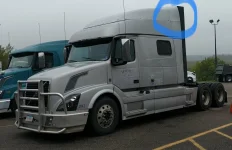
It’s probably cheaper at this point to sell the POS Volvo and buy a properly specced truck for flatbed work isn’t it?Regardless of what torque is multiplied where. Shock load is what causes the breakage.
You forgot to budget for removal of Volvo hood and installation of plywood.It’s probably cheaper at this point to sell the POS Volvo and buy a properly specced truck for flatbed work isn’t it?
Change the rear axle ratios, taller fifth wheel mount, remove the skirts, open the drives to 60” means new driveshaft, needs beacons n work lights...
You’re talking $20,000 pretty quick?
Well, maybe others will read this so they don’t make the mistakes MN did buying this truck. And maybe he’ll read this so he doesn’t look like a fool, trying to run a poorly specced truck for flatbed work
We all make mistakes

Curious why you push a 60" drive spacing.It’s probably cheaper at this point to sell the POS Volvo and buy a properly specced truck for flatbed work isn’t it?
Change the rear axle ratios, taller fifth wheel mount, remove the skirts, open the drives to 60” means new driveshaft, needs beacons n work lights...
You’re talking $20,000 pretty quick?
Well, maybe others will read this so they don’t make the mistakes MN did buying this truck. And maybe he’ll read this so he doesn’t look like a fool, trying to run a poorly specced truck for flatbed work
We all make mistakes