Evaluated the cost of running your trucking business lately? It's not pretty


Mike

Well-Known Member
Staff member
Everyone has their own way to calculate their costs in a trucking business. Multiple ways to come up with an accurate number..... probably.

For me, I factor in my equipment replacement costs as closely as possible. Obviously, there is a bit of speculation involved here in regards to how much replacement equipment is going to costs, what the sale of the old equipment is going to be at time of upgrade, etc...

It's been a while since I have updated this number for myself. Last time I did it, I was at a cost of around $1.60/mile. I base this off of 100,000 miles a year, which I am comfortable hitting each year. As long as I keep my average rate per mile over the course of the year at or above my cost per mile number, I'm good. If I run more than the 100,000 miles, I'm better. Your number may be 120,000, which seams to be more of an industry average, or you may build your numbers based on a cost per day. The important thing here is that you have a number, and that it is accurate.

So, since doing my numbers last, equipment costs have obviously gone up. Fuel has gone up. Everything has gone up.

Updating my numbers, and trying to to my best educated guess on what the average fuel cost will be for the year, that cost per mile for me is up near $1.90/mile. Honestly, it could be higher, but hard to really pin it down based on the rapidly fluctuating fuel costs.

With that said, padding my cost a bit to cover potentially higher fuel costs, I have a target number of $2.00/mile now.

This is to maintain all business costs, including paying myself for the 100,000 miles of driving.

So, it is safe to say, that for my operation, to build a profit into the business, it's crucial that my numbers need to exceed this $2.00/mile on all miles.

Have you updated your numbers for 2022? Because it is far different than it was in 2019.
 

Are you including your personal salary in that or is that just to operate at zero sum?

I don't have it calculated on a per mile basis. I just know what my minimum is for a week.
 
In a perfect world, I could figure out my cost of operation, add some revenue per mile in for profit, and factor in a fuel surcharge. From there, I could simply give my charge for each and every load.

In the real world, too many brokers don't care about any of that, you are going to scrape to get all you can get on some loads, and make up for it on other loads. Hence, an average number that must be maintained. If I can't maintain that number, I need to realize it quickly, see if adjustments can be made, and if not, it's time to go out of business.
 
Mines about $525 per day to meet my monthly revenue with zero miles. Add in replacement cost and I have been using $650/ day. Office pukes work 20 days per month, that’s what I need to earn my revenue in too.

If I work more days or less than that, it’s my choice.

That number includes my annual salary.

Other wise, my mileage cost for maintenance is about 18 cpm.

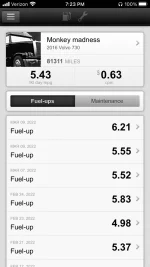
My fuel cost has been coming off Let’s Truck fuel gauges. I add 3% or about 2 cpm for DEF

B698BF57-37B0-4713-815E-7089B2C56188.png
 
I figure my trucking business the same as I would a manufacturing business.

Fixed costs / days of operation per month. Too many fleet managers seem to forget the driver has to be scheduled for down time just as equipment does. You can’t run shit 24/7 and expect it to just operate. It breaks. It wears out. You HAVE to plan those times for doing both maintenance. Partly why I stopped wrenching on shit at home. It’s my “me” maintenance time.

Maintenance and fuel are just variable materials costs.
 
Mines about $525 per day to meet my monthly revenue with zero miles. Add in replacement cost and I have been using $650/ day. Office pukes work 20 days per month, that’s what I need to earn my revenue in too.

If I work more days or less than that, it’s my choice.

That number includes my annual salary.

Other wise, my mileage cost for maintenance is about 18 cpm.

My fuel cost has been coming off Let’s Truck fuel gauges. I add 3% or about 2 cpm for DEF

View attachment 86307
I've always recommended that everyone use fuel gauges or something equivalent to not only know their fuel economy (a good tell if things are going wrong with your truck) and it gives you the exact cost of fuel per mile, rather than folks on places like Facebook claiming fuel is costing them over $1.00/mile to pull a dry van.
 
I figure my trucking business the same as I would a manufacturing business.

Fixed costs / days of operation per month. Too many fleet managers seem to forget the driver has to be scheduled for down time just as equipment does. You can’t run shit 24/7 and expect it to just operate. It breaks. It wears out. You HAVE to plan those times for doing both maintenance. Partly why I stopped wrenching on shit at home. It’s my “me” maintenance time.

Maintenance and fuel are just variable materials costs.
I do small wrenching but if it's big I'm not even going to try. Especially if it needs proprietary OE software.
 
You can’t run shit 24/7 and expect it to just operate
Exactly, and why I figure how to be profitbable with a maximum of 100,000 miles OTR, and not the 120k or 150k+ that many companies push when you are leased to them in order to be profitable. Down time is important.
 
I've always recommended that everyone use fuel gauges or something equivalent to not only know their fuel economy (a good tell if things are going wrong with your truck) and it gives you the exact cost of fuel per mile, rather than folks on places like Facebook claiming fuel is costing them over $1.00/mile to pull a dry van.
I calculate every fill-up by hand and log it all with the load in a sort of loose leaf diary. It helps me keep track of what I did, what I owed, my mileage at each stop, etc, fuel used on the trip as well as the tank, etc.

The dash is actually pretty accurate though.
 
Exactly, and why I figure how to be profitbable with a maximum of 100,000 miles OTR, and not the 120k or 150k+ that many companies push when you are leased to them in order to be profitable. Down time is important.
If I run 80,000 miles, it’s a big year.

In 10 years since I bought my truck, I have yet to even break 90,000 miles.
 
I installed a new alternator into my apu tonight in the parking lot.

Took about an hour. Cost me $200 for the part and resulted in no down time. Probably saved me $300 labor and $200 in parts.
I was proud to have done my leveling valve, air dryer, and shocks. My slab is kind of like a parking lot. 👍

I don't know if I ever want to mess with the tires and drums to do the brakes though. My memories from doing the Ford for the wheel studs aren't fond. 😃
 
I also won't do anything that requires long arms. Like that safety valve or whatever it's called up on the frame rail. My little stubs can't reach it and when I try, stuff like that hurts...a lot.
 
For you, that would be your number to base cost per mile on if you weren't running on a cost per day program.
In accounting, that’s why you don’t run fixed costs against a variable output.

GAAP.

Just an issue I have with the entire trucking industry.

When I finally found the textbook for truckload transportation, it just reinforces those principles.

Yes, it’s just one of many masters level course text books I’ve read over the last few years.

 
In accounting, that’s why you don’t run fixed costs against a variable output.

GAAP.

Just an issue I have with the entire trucking industry.

I get that, and it's why I don't blindly look at Rate Per Mile. I use it as an endgame for the 100,000 mile target I have set up, but I don't use it for individual loads.

Many loads have multiple days involved on them. Sometimes it is simply a case where the load has to be picked up on a certain day, and cannot deliver until a certain day. My requirement on those loads in dependent on where the load is (will I be home during part of the downtime), we well as if it happens when I can benefit by resetting my 70 hour clock.

My working number here is $1200/day if it is taking up valuable time that I in which I want to be running and earning. I may drop that number a little if it's a long load that puts me in a good location to grab great paying freight, I may increase that number if the load is taking me to a bad area that I may be forced to take a low rate from, or possibly even bounce out of.

I am always trying to factor everything based on a few days ahead if that makes sense.
 
If you put fixed expenses against variable expenses like that when you write the cpa test, it would fail you.

But the industry, in general, still looks at it by the mile.

It goes against everything I was taught. So it’s just a sore spot for me.

So when the “experts” and the radio figures do this, it really sits wrong.
 
I think it's similar to a restaurant figuring its costs based on projected numbers of meals sold. They might not sell that many, they might sell more. If they sell more burgers they'll need more patties but they have to keep the lights on regardless. The patties are our fuel.

It's not really unheard of to do it this way.

I get what you're saying though. They don't calculate the business expenses on a per patty basis.

They do, however, need to sell a certain amount of meals to break even and then more to make a profit.

Our miles are the meals. It's a service but that seems to be the only way people understand or can relate to what we're doing. So if they expect us to wait or the miles are going to be a time sink to run we just jack up the per mile rate to pay for our time.

You can't bill detention on stop and go traffic.
 
By the way, when I bid, I actually bid hourly in my mind.

I plan the load out as best as I can figure and that's where I go when I bid.

People who don't think that way and actually just go straight mileage underbid me a lot.

That's another problem I'm having because they're clearly not considering dock time, then they're getting pissed when they have to wait at the shipper. It shows in the negative reviews on JB Hunt.

There are some loads I could sit and wait for, then layover at my house for fresh hours, make the delivery on time, and be good but nobody wants to pay for it to be a "2 day" split.
 

Back
Top