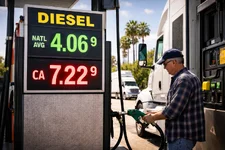
Diesel prices may not be climbing as fast as they were a few weeks ago, but that does not mean carriers can breathe easy. The latest numbers show the national average diesel price rose 2.6 cents to $4.06 per gallon, while California climbed all the way to $7.22. Regional prices were mixed, with some areas easing while California kept moving in the wrong direction.
That is the part truckers need to pay attention to.
The national average makes for a nice headline, but trucking does not run on national averages. It runs lane by lane, region by region, and load by load. A carrier running the Southeast may feel one kind of fuel market, while somebody hauling in and out of California is dealing with something completely different.
And at $7.22 a gallon, California is not just different. It is a problem.
For owner-operators and small fleets, fuel is still one of the biggest costs on the truck. When one state gets that far out of line with the rest of the country, it does more than sting at the pump. It starts affecting routing decisions, load choices, surcharge calculations, and whether certain freight is worth touching at all.
That is where this story really matters.
When diesel climbs that high in California while other regions ease off, the pressure does not hit everybody the same way. A big fleet may have stronger fuel discounts, better surcharge agreements, and more flexibility to shift freight around. A one-truck or small-fleet operation does not always have that cushion. If the rate is weak and the fuel is high, the margin can disappear in a hurry.
That is how a lot of trucking businesses get squeezed. Not always from one giant hit, but from too many loads that never really paid enough once fuel and everything else were counted.
California has always been rough on fuel costs, but once prices get pushed this high, it becomes more than just another complaint drivers make at the fuel island. It becomes a business problem. Carriers that run California regularly have to think harder about where they fuel, how they price loads, and whether their surcharge programs are actually keeping up.
If they are not, the truck may still be moving, but the money may already be gone.
There is also a freight-flow angle to this. When costs rise enough in one region, freight does not always keep moving the same way it did before. Shippers start looking at alternatives. Carriers start favoring other lanes. Some freight may get diverted, and some operators may decide certain runs are just not worth the headache unless the rate improves.
That does not mean California freight disappears. It means everybody involved starts looking for a way to protect themselves.
This is also why fuel efficiency matters even more when the market gets uneven. High-priced regions push fleets to think harder about idle time, routing, speed, equipment choices, and maintenance. A truck that saves fuel becomes a lot more valuable when the gap between one region and another gets this wide.
That is one reason these diesel stories still matter, even when people get tired of hearing about them. Fuel is one of those costs that touches every load, every dispatch decision, and every paycheck in this business. A small move in the national average may not sound like much, but a state sitting above $7 a gallon is a different story.
The trucking takeaway is simple. You cannot control the pump price, but you can control how closely you watch it. Carriers need to know where diesel is rising, where it is easing, and which lanes are getting harder to justify. Drivers need to remember that a decent-looking rate can still be a bad load when the fuel side of the equation is off.
The national average may have cooled off a little. California did not. And for trucking, that is more than a fuel story. It is a margin story.
That is the part truckers need to pay attention to.
The national average makes for a nice headline, but trucking does not run on national averages. It runs lane by lane, region by region, and load by load. A carrier running the Southeast may feel one kind of fuel market, while somebody hauling in and out of California is dealing with something completely different.
And at $7.22 a gallon, California is not just different. It is a problem.
For owner-operators and small fleets, fuel is still one of the biggest costs on the truck. When one state gets that far out of line with the rest of the country, it does more than sting at the pump. It starts affecting routing decisions, load choices, surcharge calculations, and whether certain freight is worth touching at all.
That is where this story really matters.
When diesel climbs that high in California while other regions ease off, the pressure does not hit everybody the same way. A big fleet may have stronger fuel discounts, better surcharge agreements, and more flexibility to shift freight around. A one-truck or small-fleet operation does not always have that cushion. If the rate is weak and the fuel is high, the margin can disappear in a hurry.
That is how a lot of trucking businesses get squeezed. Not always from one giant hit, but from too many loads that never really paid enough once fuel and everything else were counted.
California has always been rough on fuel costs, but once prices get pushed this high, it becomes more than just another complaint drivers make at the fuel island. It becomes a business problem. Carriers that run California regularly have to think harder about where they fuel, how they price loads, and whether their surcharge programs are actually keeping up.
If they are not, the truck may still be moving, but the money may already be gone.
There is also a freight-flow angle to this. When costs rise enough in one region, freight does not always keep moving the same way it did before. Shippers start looking at alternatives. Carriers start favoring other lanes. Some freight may get diverted, and some operators may decide certain runs are just not worth the headache unless the rate improves.
That does not mean California freight disappears. It means everybody involved starts looking for a way to protect themselves.
This is also why fuel efficiency matters even more when the market gets uneven. High-priced regions push fleets to think harder about idle time, routing, speed, equipment choices, and maintenance. A truck that saves fuel becomes a lot more valuable when the gap between one region and another gets this wide.
That is one reason these diesel stories still matter, even when people get tired of hearing about them. Fuel is one of those costs that touches every load, every dispatch decision, and every paycheck in this business. A small move in the national average may not sound like much, but a state sitting above $7 a gallon is a different story.
The trucking takeaway is simple. You cannot control the pump price, but you can control how closely you watch it. Carriers need to know where diesel is rising, where it is easing, and which lanes are getting harder to justify. Drivers need to remember that a decent-looking rate can still be a bad load when the fuel side of the equation is off.
The national average may have cooled off a little. California did not. And for trucking, that is more than a fuel story. It is a margin story.