Well, it looks like there are going to be a lot of sitting in the road resets going on through that mess. I'm sure it won't be cleaned up in an hour. It's usually a 10 hour road closure for a fatality. Being in a tunnel sure isn't going to make it any easier.
Two trucks entering a tunnel side by side are like a piston in a cylinder.
Air pressure is going to spike, people's ears will pop, cars tailgating those two trucks might get sucked along through the tunnel, hitting one of the trucks if they don't let off the gas quick enough.
So they have parallel air shafts and crossover tunnels just for air pressure to balance out.
Also fans that remove vehicle exhaust fumes.
And service tunnels for maintenence workers, all the electrical wiring for the lights and fans, and some kind of drainage system for water (unless the tunnel goes uphill to the center then downhill)
That's a lot of stuff that will need to be inspected and fixed.
And of course, any tunnel is at risk of a cave-in without proper roof support.
The heat from the fire will require inspection of roof supports, especially if it's heat treated steel, or concrete. Ever take a propane torch to concrete? It chips and cracks.
I'd say that the tunnel bore that had the fire in it is going to be closed for a long time.
However if the eastbound tunnel didn't have a fire in it (or the westbound, I forgot which one had the fire) they could probably have it open for two-way traffic in a week or two.
This is a completely unqualified guess though. I've never worked in highway or tunnel maintenance.
But I do know that there will be PhD's and geologists and other fascinating science nerds called to the scene after the initial cleanups.


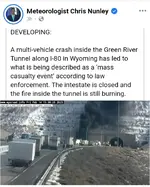
 apnews.com