Autonomous trucking keeps getting talked about like it is some far-off idea, but this time it is not a concept video or a test track demo. It is moving real freight on a real route.
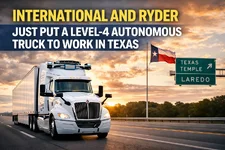
International Trucks and Ryder have launched a Level-4 autonomous truck pilot on a 600-mile run between Laredo and Temple, Texas. The truck is an International LT Series equipped with factory-installed sensors and Plus’s SuperDrive autonomous software. A Ryder driver is still in the seat to supervise, but the system is handling the driving for most of the trip. Early results say the truck delivered 100 percent on time, ran 92 percent of the route under autonomous control, and showed better fuel efficiency than a human-driven baseline.
That is the kind of update this industry pays attention to.
For years, automation talk in trucking has mostly lived in the world of promises. Better safety. Better fuel economy. More consistency. Less fatigue. The problem has always been that a lot of the talk got ahead of the proof. This pilot feels different because it puts numbers behind the pitch. When a major truck maker, a large fleet operator, and a real freight lane are all involved at once, it stops sounding like theory and starts looking more like the early stages of a business model.
That does not mean drivers are disappearing tomorrow. It does mean the industry is moving closer to a future where some highway freight may be handled differently than it is today.
The route matters too. Laredo is one of the biggest freight gateways in the country, and Texas has been one of the main proving grounds for autonomous trucking for a while now. If companies are going to test this technology where freight is heavy, lanes are long, and the business case can actually be measured, this is exactly the kind of corridor they are going to use.
For truck drivers and owner-operators, the biggest question is the same one it has been for years. Is this something to watch, or is this something to worry about?
Right now, it is both.
On one hand, this is still a pilot. There is still a human in the truck. The system is still being supervised. The rollout is limited. So no, this is not a case where fleets across the country suddenly replace drivers next month. Anybody pushing that story is getting way ahead of reality.
On the other hand, the direction is hard to ignore. If a truck can run 92 percent of a 600-mile route under autonomous control, stay on schedule, and use less fuel, the companies behind it are going to keep pushing. They are not spending this kind of money just to leave it in the testing phase forever.
That is where the rest of the industry needs to pay attention.
If autonomous trucks start proving they can handle long highway stretches efficiently, that could change how certain lanes are priced, how dedicated freight is moved, and how larger carriers position themselves with shippers. It could also put pressure on owner-operators and smaller fleets if customers start chasing lower-cost service on lanes that are easier to automate.
Insurance will be another part of the conversation. If autonomy reduces crashes and improves consistency, some will argue these trucks deserve better insurance treatment. If there are major failures, the argument goes the other way. Either way, the insurance side of trucking is not going to ignore this.
The equipment side matters too. This pilot uses factory-installed sensors, and that is a big detail. It tells you this is not just somebody bolting experimental hardware onto a truck after the fact. It suggests OEMs are getting more serious about building autonomous-ready equipment into the truck itself. Once that starts happening, autonomy moves closer to being part of product strategy, not just a research project.
Ryder’s involvement matters for another reason. The plan is not just to keep testing. The companies say they want to expand the pilot and eventually offer autonomous trucks in Ryder’s dedicated rental fleet. That is a big step because it points toward commercialization. A pilot is one thing. A rental fleet offering is something else. That means they are not only testing whether the technology works. They are testing whether customers will actually pay for it.
For drivers, this story is not really about panic. It is about understanding where the pressure points are most likely to show up first. Long, repeatable highway lanes are the obvious target. Dedicated freight is the obvious target. Major freight corridors in states that welcome this kind of testing are the obvious target. The closer your operation is to that kind of freight, the more attention you should be paying.
At the same time, trucking is still more complicated than just running a truck down the interstate. Weather changes. Traffic changes. Construction zones show up. Shipping schedules move. Docks get backed up. Customers make mistakes. Real trucking has always been messier than the pitch deck. That is one reason many drivers still roll their eyes when they hear automation hype. Running the road is one thing. Running the business is another.
Still, this pilot deserves attention because it is one more sign that the technology is moving forward whether drivers like it or not. The smart response is not blind fear, and it is not blind trust either. It is to watch where the technology is gaining ground, who is investing in it, and what kinds of freight it is targeting first.
International, Ryder, and Plus are not just testing a truck here. They are testing how close the industry is to accepting autonomous freight as part of normal operations. That is why this story matters. It is not about replacing every driver tomorrow. It is about showing how the first real pieces of that future may start taking shape.
International Trucks and Ryder have launched a Level-4 autonomous truck pilot on a 600-mile run between Laredo and Temple, Texas. The truck is an International LT Series equipped with factory-installed sensors and Plus’s SuperDrive autonomous software. A Ryder driver is still in the seat to supervise, but the system is handling the driving for most of the trip. Early results say the truck delivered 100 percent on time, ran 92 percent of the route under autonomous control, and showed better fuel efficiency than a human-driven baseline.
That is the kind of update this industry pays attention to.
For years, automation talk in trucking has mostly lived in the world of promises. Better safety. Better fuel economy. More consistency. Less fatigue. The problem has always been that a lot of the talk got ahead of the proof. This pilot feels different because it puts numbers behind the pitch. When a major truck maker, a large fleet operator, and a real freight lane are all involved at once, it stops sounding like theory and starts looking more like the early stages of a business model.
That does not mean drivers are disappearing tomorrow. It does mean the industry is moving closer to a future where some highway freight may be handled differently than it is today.
The route matters too. Laredo is one of the biggest freight gateways in the country, and Texas has been one of the main proving grounds for autonomous trucking for a while now. If companies are going to test this technology where freight is heavy, lanes are long, and the business case can actually be measured, this is exactly the kind of corridor they are going to use.
For truck drivers and owner-operators, the biggest question is the same one it has been for years. Is this something to watch, or is this something to worry about?
Right now, it is both.
On one hand, this is still a pilot. There is still a human in the truck. The system is still being supervised. The rollout is limited. So no, this is not a case where fleets across the country suddenly replace drivers next month. Anybody pushing that story is getting way ahead of reality.
On the other hand, the direction is hard to ignore. If a truck can run 92 percent of a 600-mile route under autonomous control, stay on schedule, and use less fuel, the companies behind it are going to keep pushing. They are not spending this kind of money just to leave it in the testing phase forever.
That is where the rest of the industry needs to pay attention.
If autonomous trucks start proving they can handle long highway stretches efficiently, that could change how certain lanes are priced, how dedicated freight is moved, and how larger carriers position themselves with shippers. It could also put pressure on owner-operators and smaller fleets if customers start chasing lower-cost service on lanes that are easier to automate.
Insurance will be another part of the conversation. If autonomy reduces crashes and improves consistency, some will argue these trucks deserve better insurance treatment. If there are major failures, the argument goes the other way. Either way, the insurance side of trucking is not going to ignore this.
The equipment side matters too. This pilot uses factory-installed sensors, and that is a big detail. It tells you this is not just somebody bolting experimental hardware onto a truck after the fact. It suggests OEMs are getting more serious about building autonomous-ready equipment into the truck itself. Once that starts happening, autonomy moves closer to being part of product strategy, not just a research project.
Ryder’s involvement matters for another reason. The plan is not just to keep testing. The companies say they want to expand the pilot and eventually offer autonomous trucks in Ryder’s dedicated rental fleet. That is a big step because it points toward commercialization. A pilot is one thing. A rental fleet offering is something else. That means they are not only testing whether the technology works. They are testing whether customers will actually pay for it.
For drivers, this story is not really about panic. It is about understanding where the pressure points are most likely to show up first. Long, repeatable highway lanes are the obvious target. Dedicated freight is the obvious target. Major freight corridors in states that welcome this kind of testing are the obvious target. The closer your operation is to that kind of freight, the more attention you should be paying.
At the same time, trucking is still more complicated than just running a truck down the interstate. Weather changes. Traffic changes. Construction zones show up. Shipping schedules move. Docks get backed up. Customers make mistakes. Real trucking has always been messier than the pitch deck. That is one reason many drivers still roll their eyes when they hear automation hype. Running the road is one thing. Running the business is another.
Still, this pilot deserves attention because it is one more sign that the technology is moving forward whether drivers like it or not. The smart response is not blind fear, and it is not blind trust either. It is to watch where the technology is gaining ground, who is investing in it, and what kinds of freight it is targeting first.
International, Ryder, and Plus are not just testing a truck here. They are testing how close the industry is to accepting autonomous freight as part of normal operations. That is why this story matters. It is not about replacing every driver tomorrow. It is about showing how the first real pieces of that future may start taking shape.